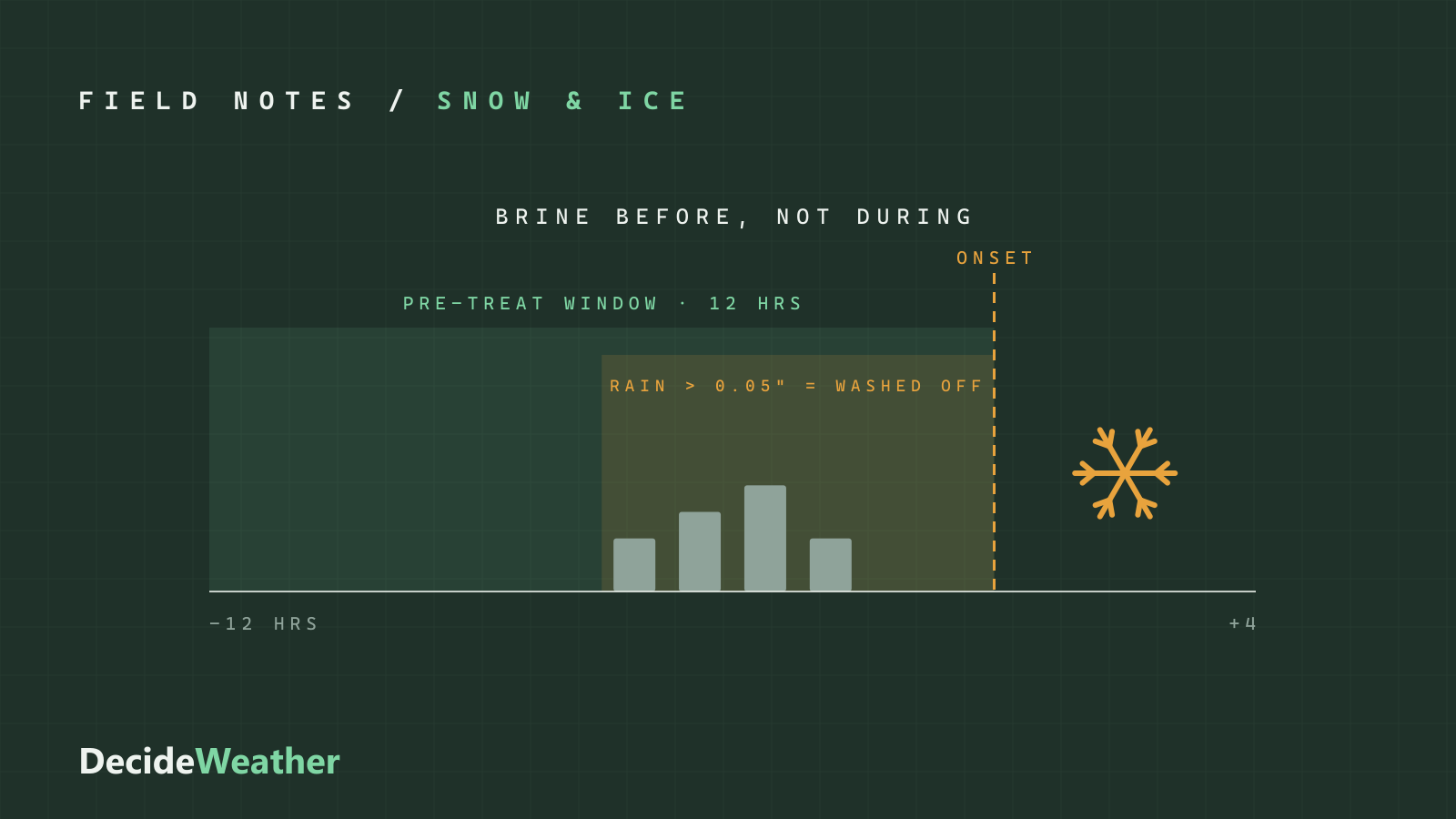
Anti-icing is the cheapest ice control there is. A thin layer of brine on the pavement before a storm keeps snow and ice from bonding, so the first plow pass scrapes clean instead of packing a layer down. But the savings depend on timing. Brine does its job inside a window, and outside it you’re paying for liquid that gets washed away or diluted.
Why pre-treating works
Snow and ice cause the most trouble when they bond to the pavement. We’ve covered why ice is a bond problem, and snow compacted by traffic becomes one too. Brine applied beforehand leaves a layer of salt on the surface that keeps the first snow from bonding. Cleanup then takes less material, less time, and fewer passes than deicing after the fact.
The window has two edges
Too early:
- Traffic scatters it, especially in drive lanes.
- Wind and dry weather can leave it thin.
- Any rain before the storm washes it off.
Too late:
- Brine applied as snow starts is still wet, and it gets diluted before it can do its job.
- Once snow is packed down, you’ve missed the chance. Now you’re deicing.
The practical window is the hours before onset, often in the preceding evening for an overnight storm. The brine needs time to dry on the pavement and should still be there when the first flakes fall.
When not to brine
- Rain before the snow. This is the biggest waste. A storm that starts as rain and changes to snow washes the pre-treatment off before it’s needed. Plan to treat around the changeover instead.
- Very cold pavement. Salt brine’s working range bottoms out in the mid-teens. Below that it can refreeze into a slick film. Switch to treated brine or another chemical.
- Blowing snow on very cold, dry days. Fine, dry snow may not stick to dry, cold pavement. A wet pre-treat can give it something to stick to.
The pre-treat window, shown as a phase
In DecideWeather, a snow or ice storm appears on the Job Site card as an event with phases, and pre-treat is the first phase. It’s a 12-hour window leading up to onset. The window shows one of four states:
- Normal: a good pre-treat opportunity.
- Suppressed: more than 0.05 inches of rain is forecast in the final six hours before onset, enough to wash the treatment off. The app shows this so you don’t send a truck to put down product the rain will remove.
- Below limit: the forecast air temperature stays below your de-icer’s working floor for two hours or more. The app has floors for rock salt, salt brine, magnesium chloride, and calcium chloride, and you choose your product in the snow settings.
- Near limit: the forecast air temperature sits within 3°F of that floor for two hours or more.
Pre-treat is armed automatically for ice and for sub-plowable nuisance snow. For plowable storms, it follows your pre-treat setting.
The comparison uses air temperature, because that’s what the forecast provides reliably. Pavement can run a few degrees either way. On a cold, clear night after a cold stretch, expect the pavement to be colder than the air, and keep more margin than the app shows.