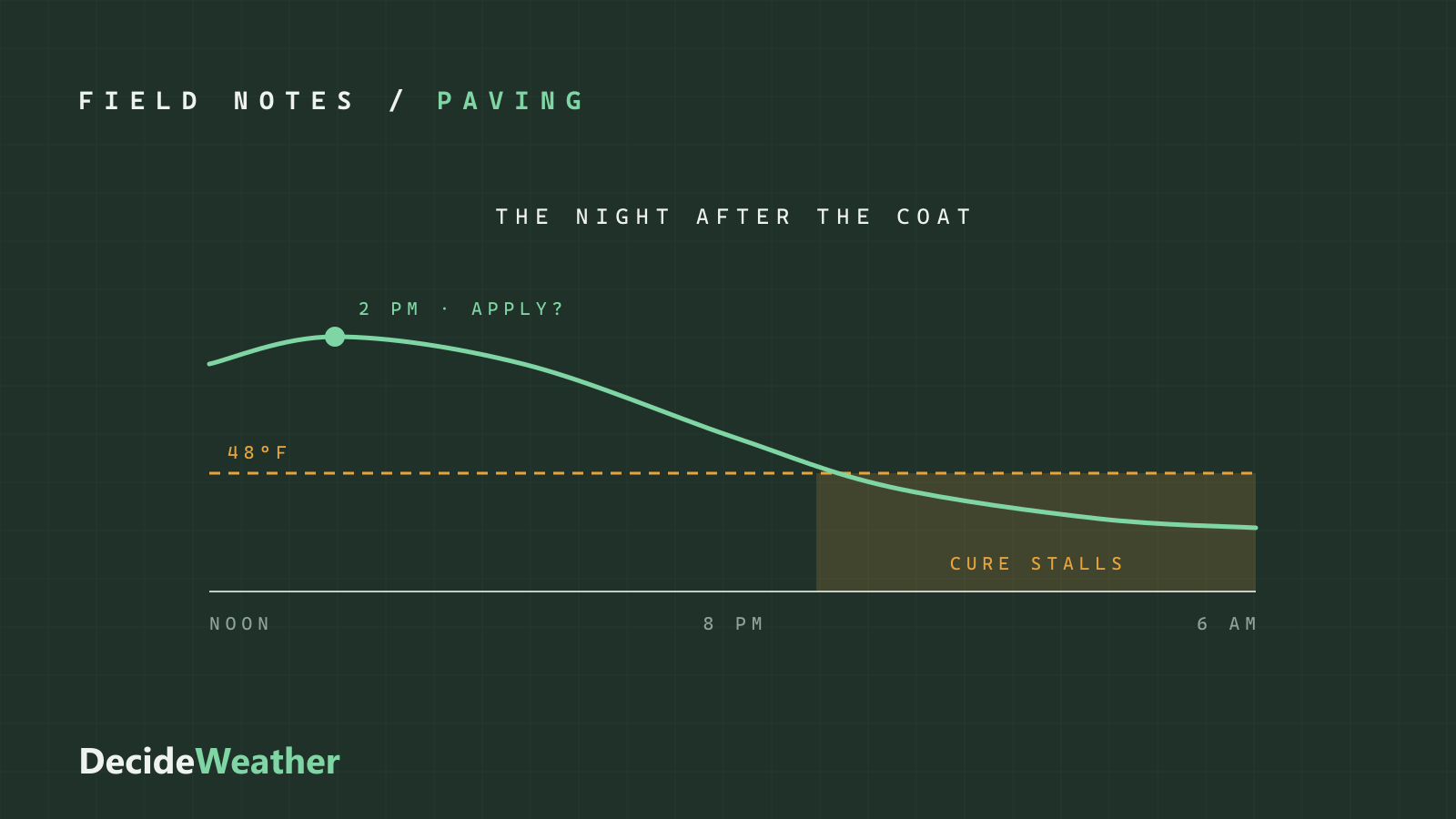
Fall is a busy sealcoating season. Summer’s backlog is still on the board, property managers want lots sealed before winter, and the afternoons are often perfect: 62°F, sunny, low humidity. So the crew seals the lot at 2 p.m. and it looks great. By morning it’s soft, tracked, and blotchy. Fall sealcoat jobs rarely fail at application. They fail overnight.
Sealcoat cures by evaporation
Asphalt emulsion sealers cure as the water leaves. The film first sets enough to shed light moisture, then keeps curing for a day or more until it can take traffic. Evaporation needs warmth, dry air, and ideally some sun and air movement. We’ve covered how humidity alone can split two 80° days. In fall, all three of those fade at the same time, every evening.
That’s why manufacturers specify more than an application temperature. The common requirement is about 50°F and rising at application, with no drop below 50°F for the next 24 hours. The details vary by product, so the data sheet is the authority, but the principle is always the same: the cure period has to stay warm too.
How a fall day goes wrong
Look at the temperature curve for a typical October day:
- 2 p.m.: 63°F, sunny. Perfect for application.
- 6 p.m.: 55°F. The sun is low and the pavement is losing heat. Curing slows.
- 9 p.m.: 47°F. Humidity is rising toward the dew point. Evaporation has almost stopped.
- Overnight: dew forms on the lot. The coat that was “set” at dusk is now wet on top and soft underneath.
The afternoon high passed every check. The overnight low failed the job. Add a late-night shower and the same coat can wash into the storm drains before it ever cures.
Reading a fall seal day
- Check the next 12 to 24 hours, not the afternoon. If the low drops below your product’s minimum, apply early or move the job.
- Watch the humidity climb. Humidity near saturation in the evening means evaporation stops, even if the temperature is still in the 50s.
- Front-load the day. A lot sealed at 10 a.m. gets hours more drying than one sealed at 3 p.m. In October, that difference often decides the job.
- Count the rain after, not just during. A coat needs a dry stretch to set and a longer dry stretch to cure. The post-rain surface is its own question.
The look-ahead is built in
DecideWeather’s Sealcoating operation reads the night after the coat as part of today’s call:
- Temperature: air below 48°F is a Stop, and so is a forecast low under 48°F anywhere in the next 12 hours, even when the application hours look fine.
- Humidity: 90% or higher is a Stop, and 80–90% is a Caution.
- Rain before it firms up: 0.02 inches or more in the next 12 hours is a Stop.
- Rain during the cure: 0.07 inches or more in hours 12–24 is a Stop, and 0.02–0.07 inches in that window is a Caution.
The TONIGHT tab on each Job Site card shows the low, the rain chance, and the overnight precipitation total for the hours after your workday ends. That’s where fall sealcoat jobs are won or lost.