Everyone watches for plastic shrinkage cracking in July. Nobody expects it on a 65°F October afternoon with a nice breeze and blue sky, and that’s exactly why fall slabs crack. Evaporation isn’t a heat problem. It’s a drying problem, and wind and dry air are drying agents on any day.
What plastic shrinkage cracking is
While concrete is still plastic, water bleeds to the surface. If that water evaporates faster than bleed water replaces it, the surface dries and shrinks while the concrete underneath doesn’t. The surface tears. The result is short, often parallel cracks that show up within the first few hours, sometimes while the finishers are still on the slab.
The cracks can be shallow or run deep, and they give water and deicing salts a path into the slab for its whole life.
The evaporation math
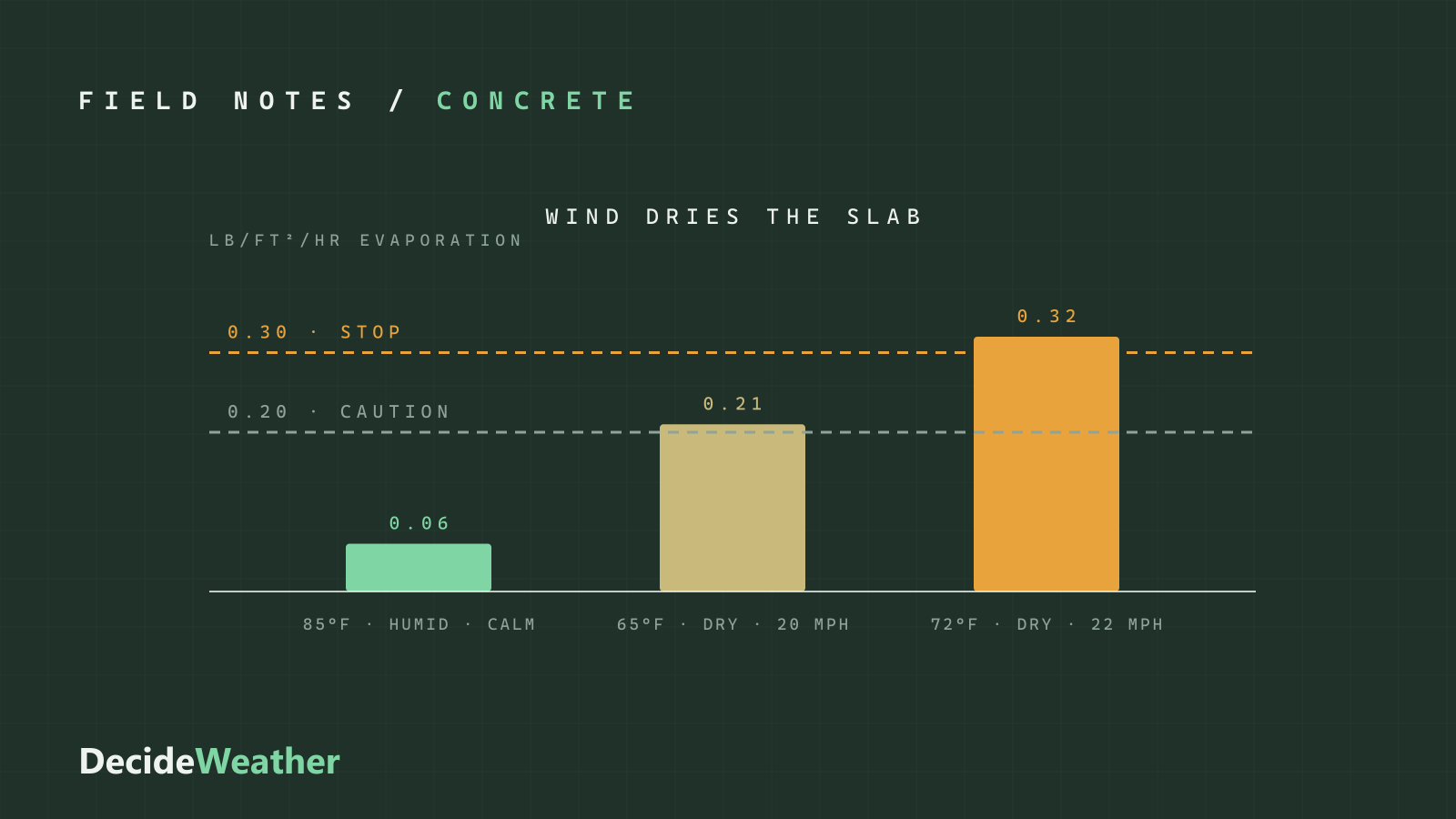
The evaporation rate from fresh concrete depends on four things: concrete temperature, air temperature, humidity, and wind. The ACI nomograph combines them, and we’ve covered it for hot-weather pours. ACI 305 guidance says precautions are needed once the rate passes about 0.2 lb/ft²/hr.
Run the numbers on three days:
- 85°F, humid, calm. Warm, but the air is already moist and there’s no wind to carry moisture away. The rate is low, around 0.06.
- 65°F, 30% humidity, 20 mph wind. A pleasant fall day behind a cold front. The rate is about 0.21, over the precaution line.
- 72°F, 25% humidity, 22 mph wind. A dry, breezy fall afternoon. About 0.32.
The cool, dry, windy days beat the hot humid one by a wide margin. Wind has a large effect because it keeps replacing the moist air layer above the slab with dry air, and dry fall air masses are very thirsty.
The warm-concrete-in-cold-air effect
There’s a factor the table above leaves out: concrete temperature. In fall, concrete often leaves the plant warmer than the air, thanks to heated water, warm aggregates, or its own hydration heat. The greater the gap between warm concrete and cool, dry air, the faster the slab loses water. Any estimate based on air temperature alone will be low on those days. When the weather already reads marginal and you know the mix is running warm, treat a Caution as a Stop.
Protecting the slab
- Windbreaks on the upwind side, especially on open sites.
- Evaporation retarders sprayed on between finishing passes. They reduce moisture loss without adding water to the surface.
- Fog misting above the slab to raise humidity. Fog, not a hose: water sprayed onto the surface weakens it.
- Start curing immediately after finishing: curing compound, wet burlap, or plastic.
- Pour earlier in the day when fall winds often haven’t picked up yet.
Evaporation, read hourly
DecideWeather calculates the evaporation rate for every hour of a Pour using the same kind of formula behind the ACI nomograph. It combines each hour’s forecast temperature, humidity, and wind. Because there’s no forecast for the temperature of the concrete itself, it uses air temperature in that slot. That’s why warm mixes deserve the extra margin described above.
- 0.20 to 0.30: a Caution, with a note pointing to ACI 305 practice.
- 0.30 and above: a Stop.
- Wind on its own: sustained wind of 25 mph or more, or gusts of 35 or more, is also a Stop for the pour.
The hourly bar on the Job Site card shows the rate’s course through the day. That makes it easy to see that the pour works at 7 a.m. and doesn’t at 1 p.m., when the cold front’s wind arrives.