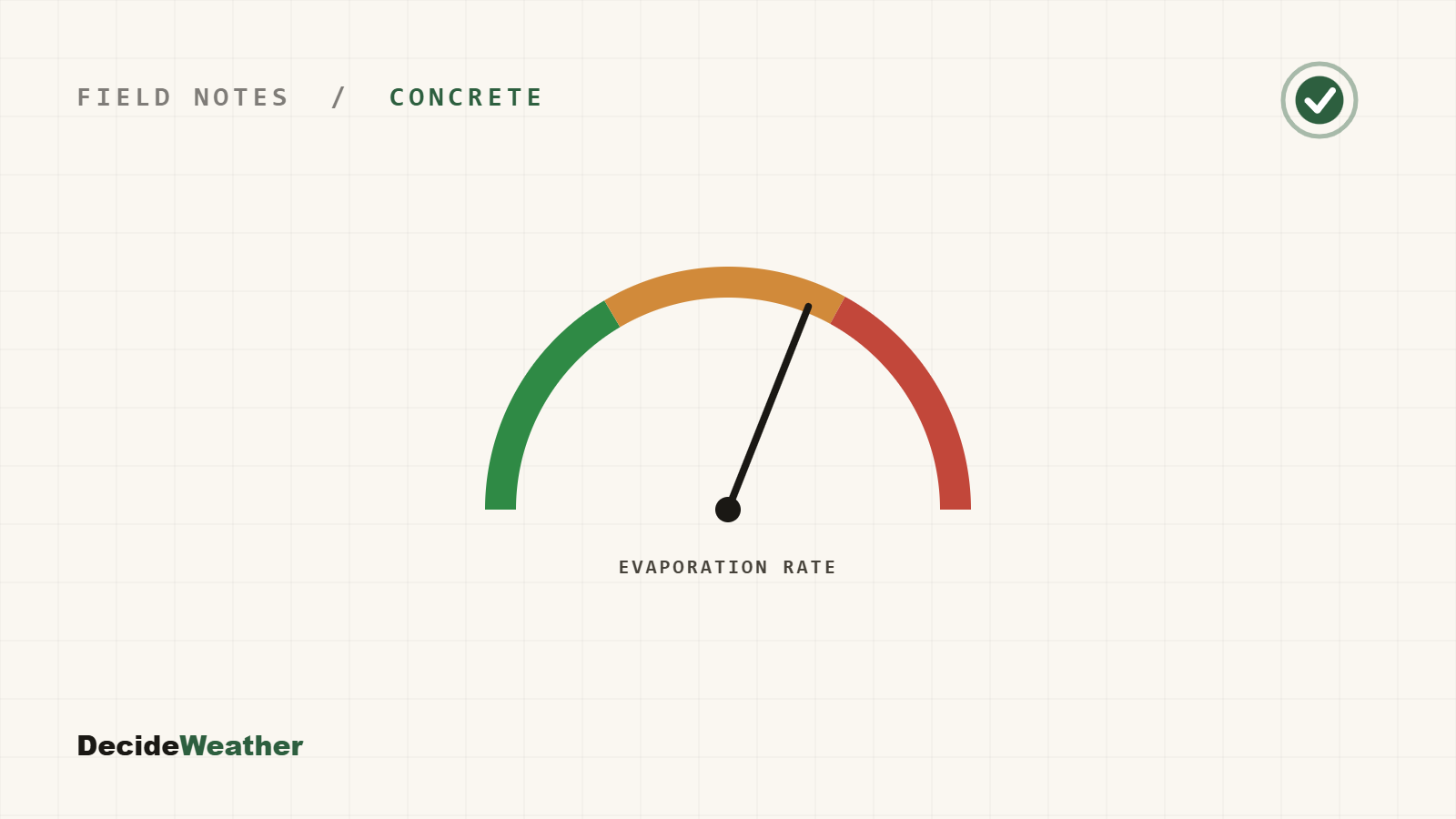
Plastic shrinkage cracking starts long before 90°F. Here's why wind, humidity, and concrete temperature — the evaporation rate — decide a safe pour window.
The short answer Hot-weather concrete cracks when surface water evaporates faster than bleed water replaces it — the evaporation rate, driven by concrete temperature, air temperature, humidity, and wind together, is the real limit, not the day's high.
Ask what stops a hot-weather pour and most people say the temperature. But slabs crack from water leaving the surface too fast — and that’s driven by a combination, not a single number.
Evaporation rate is the real metric
The rate water evaporates off fresh concrete rises with wind speed, low humidity, high air temperature, and a warm concrete temperature. Any one can be moderate while the combination pushes you into plastic-shrinkage-cracking territory. A breezy, dry 78° morning can be riskier than a still, humid 90° afternoon.
What feeds the call
- Wind speed at the slab — the biggest multiplier
- Relative humidity — how thirsty the air is
- Air and concrete temperature — both matter, separately
- Timing — pouring into a rising or falling evaporation rate
A window, not a temperature limit
Instead of a single cutoff, the safe pour is a window where the evaporation rate stays under control — often early morning or evening on a hot, breezy day. DecideWeather models that rate and turns it into a Go / Caution / Stop recommendation for pours, so you place concrete when it can hold water.
Common questions
What causes plastic shrinkage cracking in concrete?
Water leaving the slab surface faster than bleed water rises to replace it. That's driven by the combination of concrete temperature, air temperature, humidity, and wind — not by heat alone, which is why cracking can start well below 90°F.
What evaporation rate is dangerous for a concrete pour?
Industry guidance treats roughly 0.2 lb/ft²/hr as the danger threshold, with caution below it. A windy, dry, moderate day can cross it just as easily as a hot, calm one.
Can you pour concrete on a hot day?
Often yes — the question is the evaporation rate through the pour and finishing window. Timing the pour earlier, windbreaks, and evaporation retarders can keep a hot day inside a safe window.
Forecasts that know your work
Get a Go / Caution / Stop recommendation for every operation, tuned to your job site.
Start your 2-week free trial