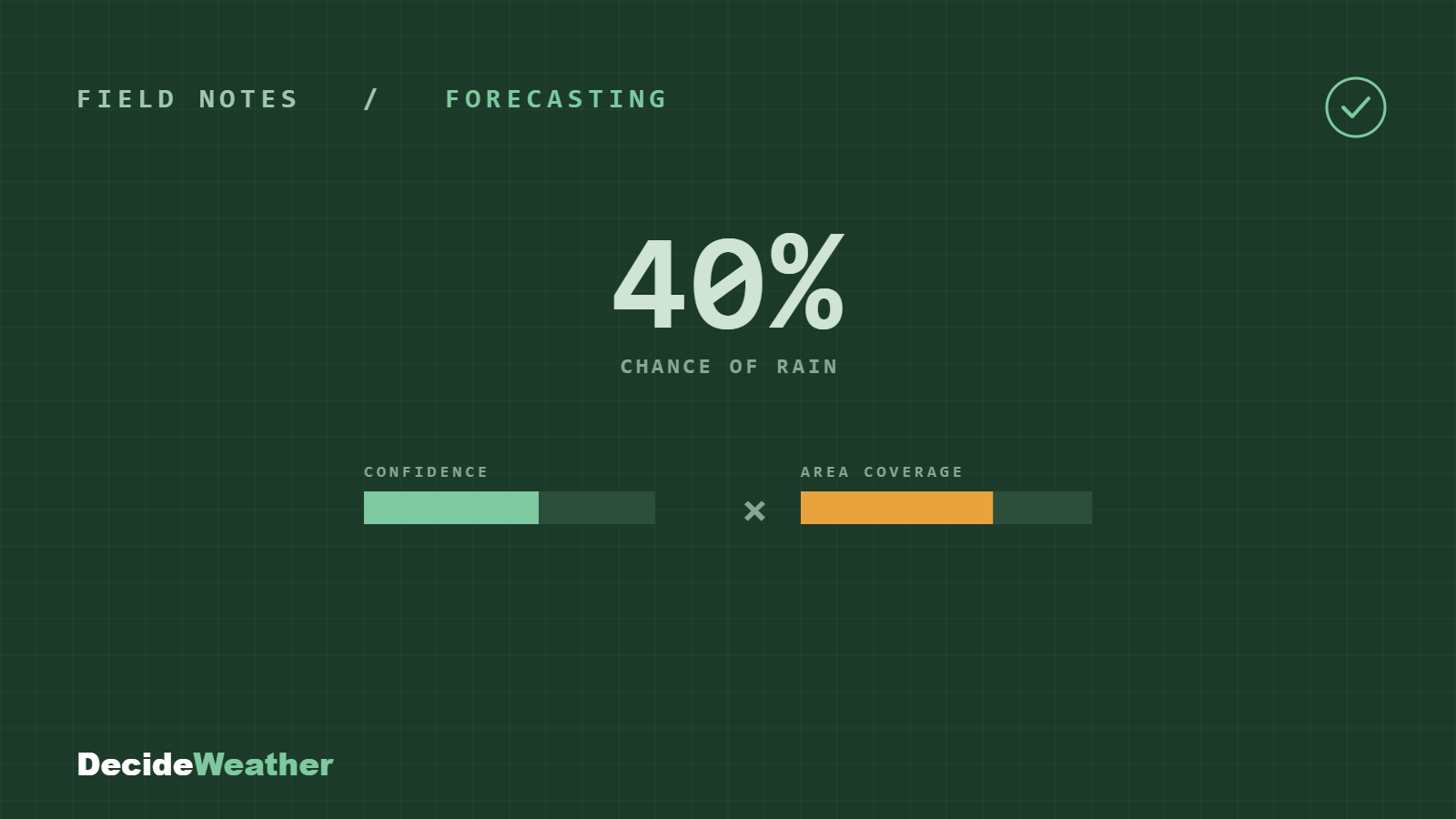
No number in a weather forecast gets misread more often than the probability of precipitation — the “40% chance of rain” on your phone. Crews plan around it, supers cancel on it, and almost everyone interprets it differently. Some think it means it’ll rain 40% of the day. Some think it means rain over 40% of the area. Some think it’s a 40% chance it rains at all, anywhere, ever. Understanding what that number actually represents — and, more importantly, what it leaves out — is one of the highest-leverage things an outdoor crew can learn about reading a forecast.
What probability of precipitation really measures
The National Weather Service defines Probability of Precipitation (PoP) as the chance that measurable precipitation — at least 0.01 inches — falls at any given point in the forecast area during the forecast period. That’s it. It’s a point probability over an area and a time window.
There’s a common formula behind it: PoP = Confidence × Coverage (Area). In plain terms, it’s the forecaster’s confidence that rain will occur somewhere, multiplied by the fraction of the area expected to get wet if it does. That single definition is why the same “40%” can mean two completely different days:
- High confidence, partial coverage: the forecaster is 100% sure rain happens, but only over about 40% of the area. → 40% PoP.
- Lower confidence, broad coverage: rain would cover the whole area if it comes, but the forecaster is only about 40% sure it materializes. → also 40% PoP.
The first is a near-certain band of scattered showers. The second is a coin-flip on a soaking. Same number, opposite implications for your day.
Why PoP alone is nearly useless for a job-site call
For scheduling outdoor work, PoP has three blind spots that matter enormously:
- It says nothing about timing. A 40% chance “today” could be a 6 a.m. shower that clears by 8, or an afternoon storm that lands right in your pour window. The number is identical; the impact on a sealcoat, a pour, or a roof tear-off is not.
- It says nothing about intensity or amount. “Measurable” means 0.01 inches — a trace that barely dampens a surface. That same 40% gives you no warning whether you’re getting a sprinkle or an inch in an hour.
- It says nothing about duration or what comes after. A brief cell that passes and clears is a delay; a stalled front that rains all afternoon is a lost day. PoP can’t tell them apart.
A single percentage is a planning hint, not a scheduling decision. Treating “40%” as a Go/No-Go switch is how crews either lose good days to caution or get caught mid-task by a storm the number technically warned about but never really described.
What to watch instead when you’re scheduling
The forecast holds far more useful detail than the headline percentage. For a job-site call, the questions that actually matter are:
- When? Hour-by-hour timing of the precipitation relative to your work window — not “today,” but “between 1 and 4.”
- How much? Expected rainfall amount and intensity, which decide whether a surface gets dampened or washed out.
- How long, and what after? Duration of the event and whether the sky clears behind it, so you know if a window reopens.
- What kind of weather? Steady frontal rain behaves nothing like scattered pop-up convection — the second can be dodged with good timing, the first usually can’t.
- How confident? Whether that 40% is high-confidence partial coverage or a low-confidence area-wide maybe.
This is exactly where a single model — and a single number — falls short, and why blending multiple models with NWS guidance and live radar (the subject of a couple of our other field notes) sharpens the same-day picture so much.
How a weather window app turns PoP into a decision
The fix isn’t to ignore probability of precipitation — it’s to put it in context with everything it leaves out. That’s what a weather window approach does: instead of handing you a bare “40%,” it translates timing, amount, duration, and confidence into something you can act on.
In DecideWeather, precipitation probability is one input among many feeding a Go / Caution / Stop recommendation tuned to your specific operation. The output isn’t a percentage you have to decode — it’s a timed window that tells you whether the next few hours are workable, when the risk peaks, and when conditions clear. The “40%” becomes “your pour window is clear until 2, with a caution band 3–5 as scattered cells move through, clearing after 6.”
So the next time you glance at a chance of rain, remember what it does and doesn’t say: it’s the odds of measurable rain at a point, blending confidence and coverage — and nothing about when, how much, or how long. Read past the headline number to the timing and the amount, and you’ll make a far better call than the percentage alone ever could.