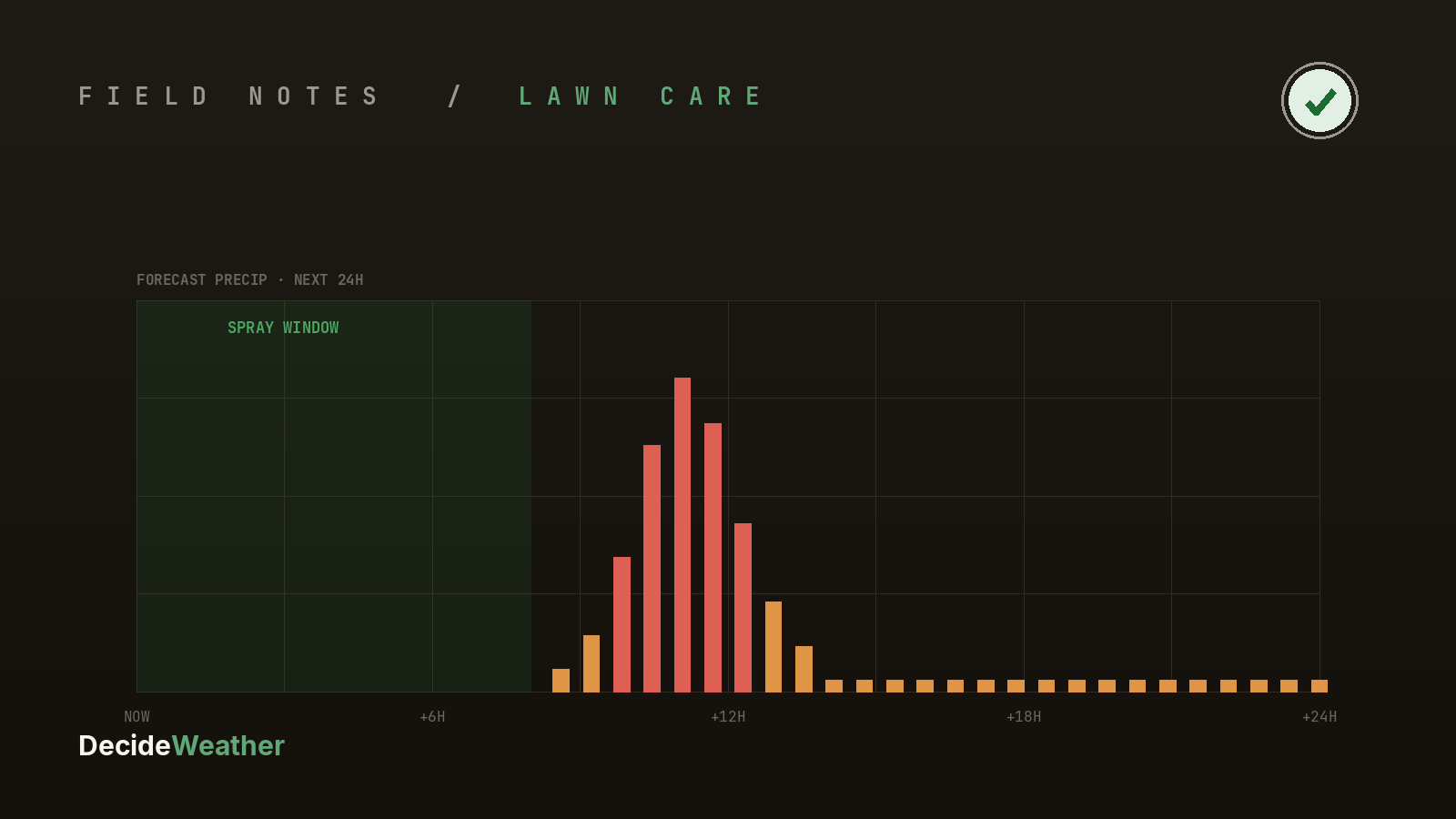
Spraying is the one lawn operation where the weather that matters hasn’t happened yet. Mowing is a right-now decision — the ground either carries the machine or it doesn’t. A liquid application is a bet on the next day, placed before you’ve seen the outcome.
Two failures, one variable
Rain after a liquid application fails in two directions at once, and it’s worth separating them.
The first is efficacy. Product that washes off the leaf before uptake is product you paid for and didn’t apply. The customer gets a partial result, you get a callback, and nothing about the lawn tells you which of those two things happened.
The second is runoff, and it’s the one with teeth. Nutrients that leave the property in stormwater end up somewhere — and in nutrient-sensitive watersheds, that’s a regulatory exposure, not just a wasted tank. This is why the wash-off call has to be conservative in a way the mowing call doesn’t. Getting mowing wrong costs you a lawn repair. Getting this wrong can cost you more than the job.
Why “is it raining?” is the wrong question
The sky at the moment you unload tells you nothing. What matters is the total precipitation over the next 24 hours — specifically, whether enough falls, soon enough, to move product before it’s taken up.
That’s a forward-looking number, and it has to be honest about probability. A forecast that shows some precipitation at every hour, at low confidence, isn’t the same as a front arriving at 4 p.m. Summing raw precipitation without gating on how likely it actually is produces a number that’s always slightly alarmed and never useful — so we gate on probability first, then sum what’s left across the window.
The other half is saturation. Soil that’s already at capacity can’t absorb anything more; the next rain runs off the surface rather than soaking in, and it takes your application with it. So the same soil-moisture reading that governs whether you rut the turf also governs whether the product stays where you put it — different reason, same measurement.
What the call looks like
-
Dry soil, clear next 24 hours: go
-
Meaningful rain inside the window: hold — the tank will still be full tomorrow
-
Borderline rain late in the window: a caution, and a reason to start early rather than skip
-
Already-saturated soil: stop, even if no more rain is coming — nothing is going to infiltrate
-
Frost on the grass: hold until it warms; cold turf isn’t taking anything up anyway
The version of this call that works isn’t a glance at the radar. It’s a forecast sum across the hours after you leave, weighted by how much you should believe it, against the soil you’re actually standing on.