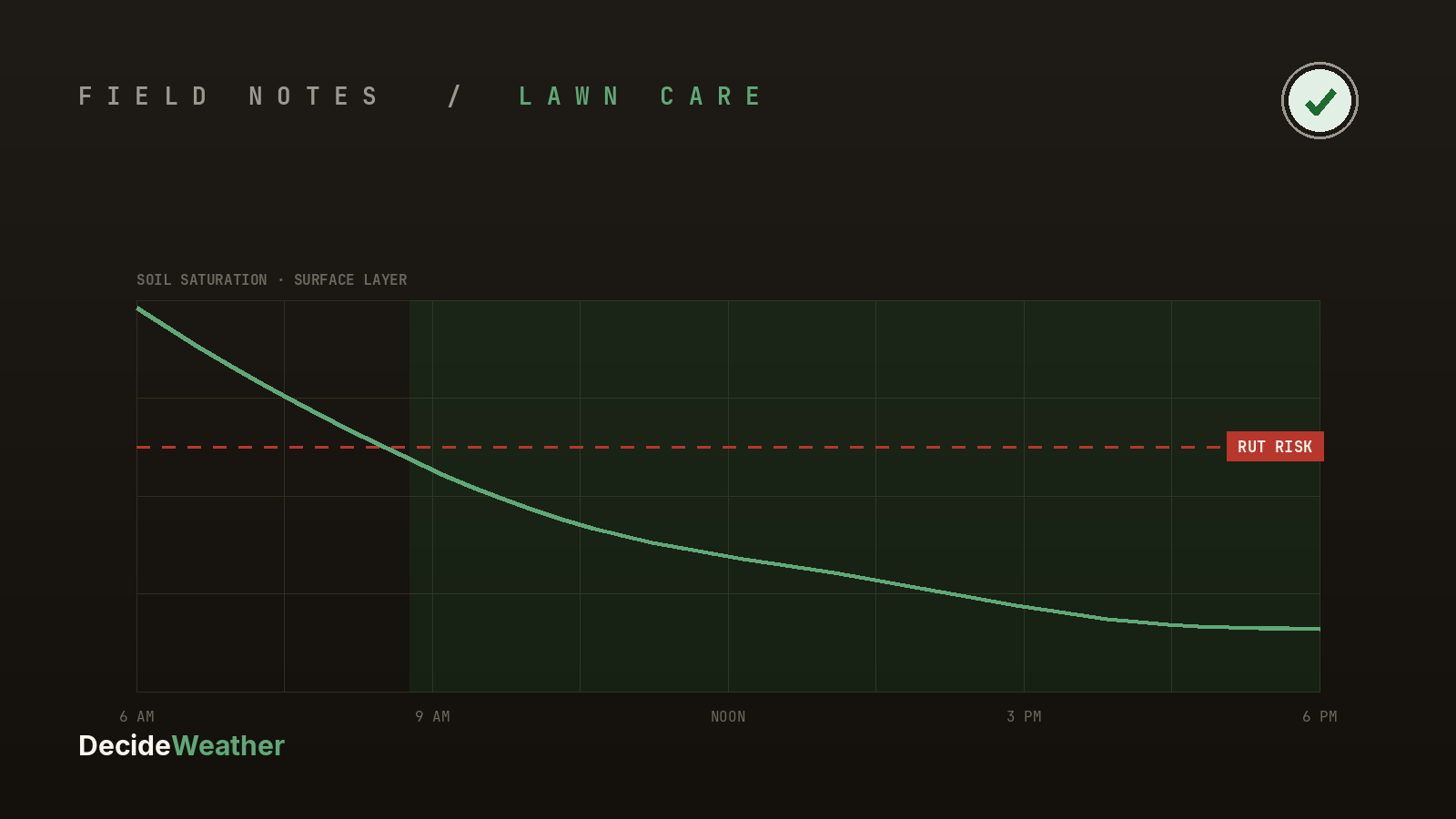
Every lawn crew has done it: the blades look dry, the sun’s been out for hours, so you drop the deck — and the first turn leaves a pair of ruts you’ll be apologizing for all season. The surface dried. The ground didn’t.
The top few inches carry the machine
Turf damage from mowing isn’t really about surface wetness. It’s about whether the soil immediately under the crown can support weight without shearing. When that layer is saturated, the water can’t move out of the way fast enough, the soil loses shear strength, and a tire that would normally roll over it starts pushing it sideways instead. That’s a rut, and on a lawn it’s a callback.
Which is why we model soil moisture in the shallow surface layer rather than reading a rain gauge. Antecedent rainfall matters, but only through what it did to the soil. An inch of rain on sandy soil two days ago may be entirely gone. Half an inch on compacted clay this morning may still have you locked out at 4 p.m.
Why yesterday’s total lies to you
Two properties on the same street can drain completely differently — soil type, slope, shade, and compaction all change how fast that surface layer sheds water. A regional rainfall number treats them as identical. It isn’t a small difference: it’s the difference between a clean cut and a repair bill.
Drying is also not linear. The surface layer sheds fast in the first few hours after rain stops, then slows dramatically. So the useful question isn’t “has it rained?” — it’s “where is this soil on its drying curve right now, and where will it be at 2 p.m. when I’m actually on site?”
What a real call looks like
-
Soil drying but not there yet: hold the morning, mow the back half of the day
-
Saturated and staying saturated: it’s a stop — not a caution, a stop
-
Surface wet, soil sound: a wet cut and a messy deck, but not turf damage
-
Frozen ground: a separate stop entirely — frozen turf shatters instead of ruts
The honest version of this call has never been about the sky. It’s about what’s happening a couple of inches down, at that specific property, in the hours you’re actually going to be standing on it. That’s the number we forecast.