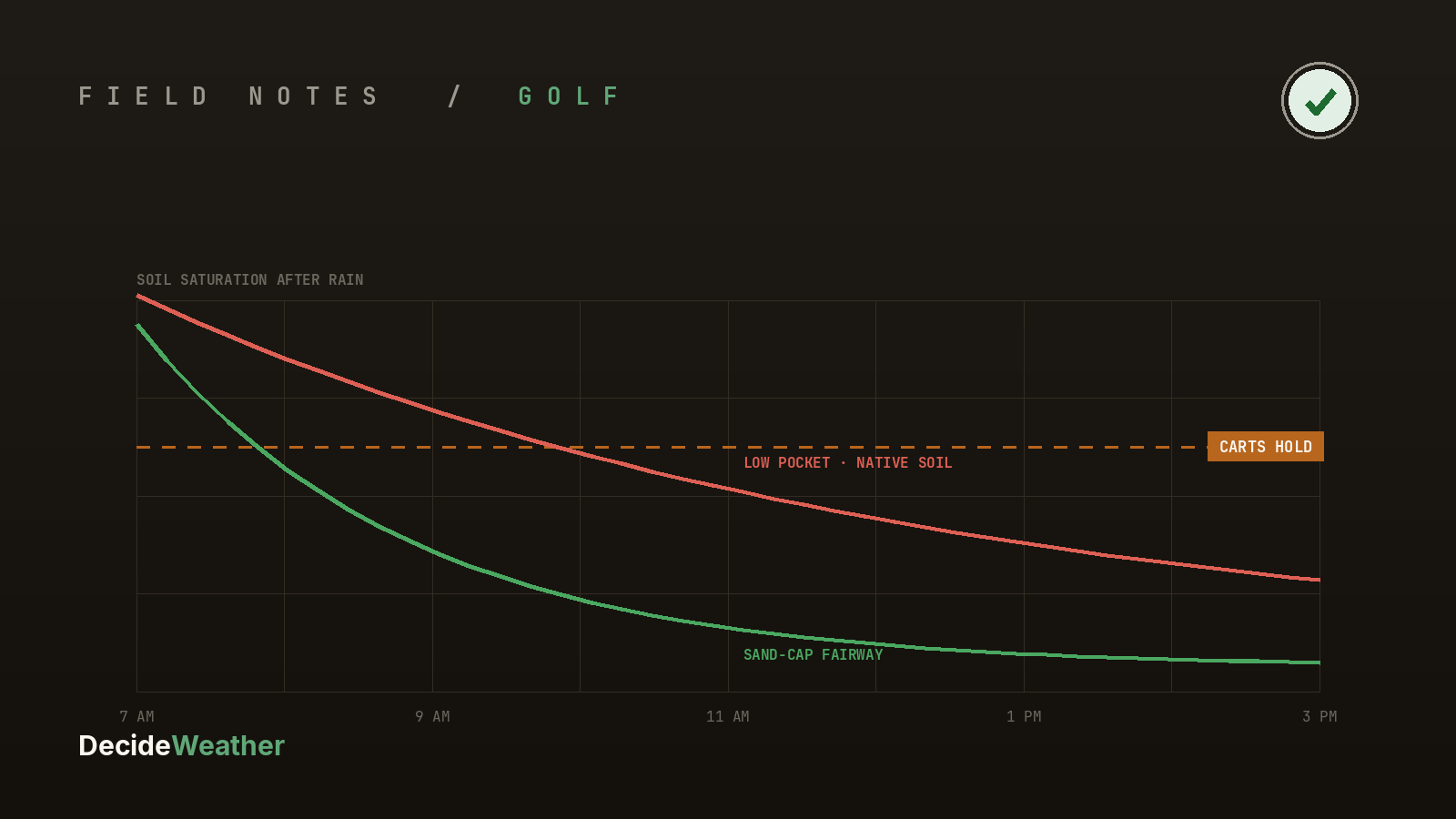
Few calls on a course cost in both directions as directly as this one. Hold carts and the shop loses revenue and the phone starts ringing. Release them onto ground that won’t carry them and you’re repairing fairways for weeks — and the damage compounds, because a rutted line concentrates every cart behind it.
The clock most people run is the wrong one
The default heuristic is elapsed time: rain stopped at seven, it’s noon, that’s five hours, we’re probably fine. It’s an understandable rule and it’s wrong often enough to be expensive.
Drying isn’t a function of hours. It’s a function of how much water went in, how fast that soil profile sheds it, and what the air has been doing since. A half-inch on a sand-capped fairway may be gone before the first tee time. The same half-inch on a heavier native soil in a low pocket can hold past mid-afternoon, on the same course, on the same morning.
What actually determines whether a tire ruts is soil moisture in the layer that carries the load — near the surface, right under the turf. When that layer is saturated, the soil loses shear strength and a tire pushes rather than rolls. That’s the mechanism, and it’s the same one that governs whether a mower ruts a lawn. Elapsed time is only a proxy for it, and a poor one.
Drying is front-loaded
The other thing time-based rules miss: the curve isn’t linear. Saturated soil sheds quickly in the first hours after rain ends, then the rate falls off sharply. So the last increment of drying — the part that actually gets you from “probably ruts” to “holds” — takes far longer than the first.
Which means the useful question isn’t “how long has it been.” It’s “where is this soil on its curve right now, and given today’s temperature, wind, and sun, where will it be at one o’clock.” That’s forecastable. Elapsed time isn’t a forecast at all; it’s a stopwatch.
What the call should rest on
-
Surface-layer soil moisture, per area of the course, not a course-wide average
-
The drying trajectory, not the time since rainfall
-
Low spots and shade, which lag the exposed fairways by hours and set the real constraint
-
What’s coming, because releasing carts an hour before the next cell arrives buys very little
-
Frozen ground: a separate stop — frozen turf doesn’t rut, it shatters
The version of this decision that protects both the tee sheet and the turf is the one that stops asking how long it’s been and starts asking what the ground is actually doing — in the specific places on your course that decide it.