Every spring there’s a week where the air says one thing and the turf says another. Warm, bright afternoons, members asking why the greens still look flat — and nothing happening, because the part of the plant that decides when the season starts isn’t the part you can see.
Roots don’t read the forecast
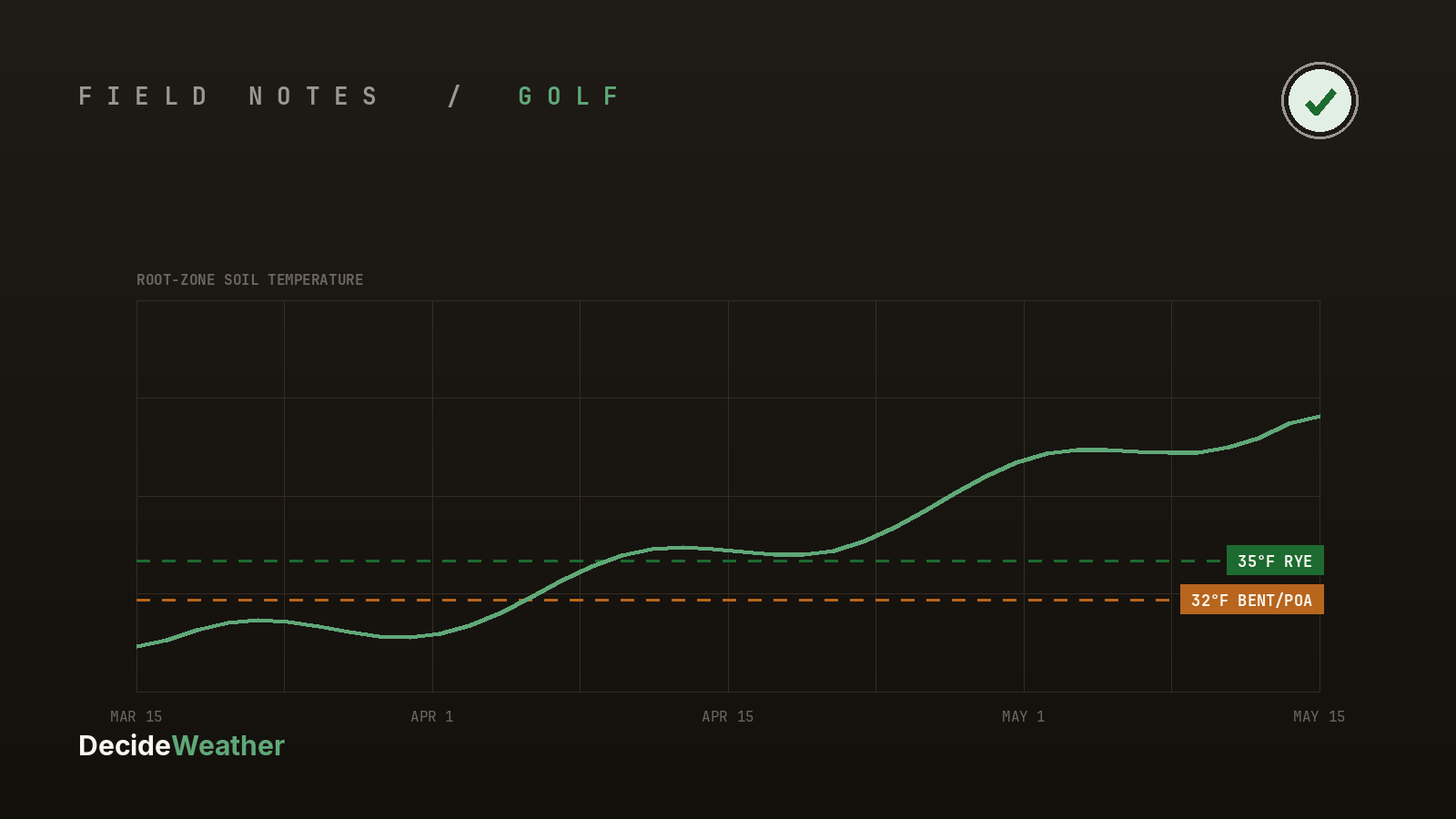
Turf growth is driven by root-zone temperature, and the root zone lags the air by a wide and variable margin. Soil has thermal mass; it warms slowly, holds heat overnight, and responds to accumulated warmth rather than to any single afternoon. A string of 65°F days in early spring can sit on top of a root zone that’s still barely above freezing.
The practical thresholds are well established. Cool-season species start meaningful growth once soil temperature at the root zone crosses roughly 32°F for bentgrass and Poa and around 35°F for ryegrass — the figures documented in the OSU and USGA work most superintendents already reference. Those are green-up thresholds, not comfort thresholds. Below them, the plant isn’t slow. It’s stopped.
Why this changes the calendar, not just the mood
Once you’re reading soil temperature rather than air temperature, a lot of spring decisions stop being calendar decisions:
The first mow isn’t scheduled — it’s triggered, when growth is actually underway and you’re removing tissue rather than injuring a dormant plant. Fertility timing follows the same logic: an application ahead of root activity is an application that mostly leaches. And frost risk stops being a binary morning question and becomes a question about how much heat the soil banked yesterday, because a warm root zone changes how quickly the surface sheds frost.
The variance across a single property is the part people underestimate. Shaded pockets and low-lying areas can run days behind an exposed fairway on the same course. A regional soil-temperature number smooths exactly the differences that determine which greens are ready and which aren’t.
What we track
- Root-zone soil temperature, not air — and per location, not per region
- The trend, because a threshold crossed once at 2 p.m. isn’t the same as a root zone that’s holding
- Overnight retention, which is what separates real green-up from a warm afternoon
- Shade and low-spot exposure, the areas that lag and set the true start date
The air temperature tells you what the day feels like walking the course. The soil temperature tells you whether the season has started. Those are rarely the same week.