Few decisions test a golf course superintendent like the morning frost call. Let carts and foot traffic onto frosted turf and you risk crushing the frozen grass blades, leaving brown footprints and tire tracks that linger for weeks. Hold the course too long and you’ve burned through prime tee times, frustrated members, and given away revenue that doesn’t come back. The frost delay is the daily collision of agronomy and operations — and getting the timing right is the whole game.
Why frost wrecks turf — and why traffic is the real damage
Frost forms when the temperature of the grass surface drops to or below the dew point and below freezing, so water vapor deposits as ice on and inside the leaf blade. A frosted blade is rigid and brittle. Walk or drive across it and the ice crystals rupture the plant’s cells from the inside. The blade may look fine that morning, but the damaged tissue dies back over the following days — which is why frost tracks show up as ghostly footprints and cart-path-width scars a week later, long after anyone remembers the morning they let play out early.
The key insight: the damage isn’t from the frost itself, it’s from traffic on frozen turf. No traffic, no track. That’s why the delay exists, and why lifting it a few minutes too early is so costly.
Air temperature lies — surface temperature tells the truth
Here’s the trap that catches a lot of frost calls: the thermometer by the clubhouse reads 38°F and a superintendent assumes there’s no frost. But the grass canopy can be several degrees colder than the air above it, especially on a calm, clear night when the turf radiates heat to a cloudless sky. The reverse is true too — a reading at the maintenance building tells you almost nothing about a low-lying fairway pocket where cold air pools and frost lingers an hour longer than everywhere else.
What actually governs whether and when frost forms and lifts:
- Grass-surface (canopy) temperature, not the air temperature at five feet.
- Dew point — frost needs the surface to hit the dew point and freezing. A dry air mass with a low dew point can skip frost entirely even on a cold morning.
- Sky cover overnight — clear skies drive radiational cooling and frost; cloud cover acts like a blanket and often prevents it.
- Wind — even a light breeze mixes the air, keeps the canopy from cooling as fast, and can suppress frost.
- Microclimate and aspect — shaded, north-facing, and low-lying holes hold frost far longer than open, sun-exposed, south-facing ground.
Timing the burn-off: it’s about the sun, not the clock
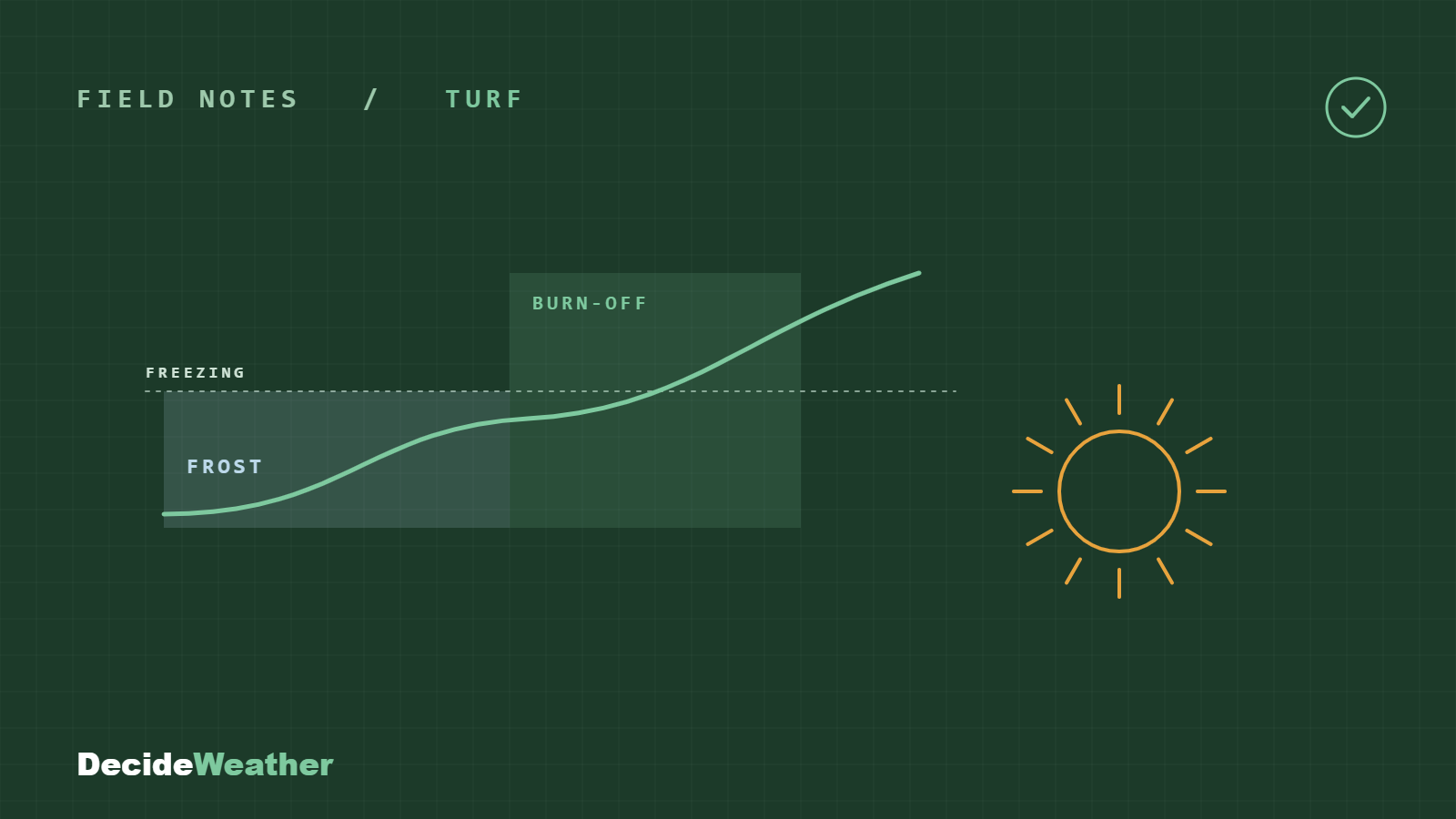
Once frost has formed, the question shifts from whether to when it lifts — the burn-off. Frost burns off as the sun rises and warms the canopy back above freezing. But “sunrise” and “burn-off” are not the same moment. The burn-off depends on:
- How far below freezing the canopy got — a hard frost takes longer to lift than a light one.
- Sun angle and exposure — open holes clear first; shaded and low pockets clear last, sometimes an hour or more behind.
- Air temperature trend and how quickly it climbs after sunrise.
- Wind picking up, which speeds mixing and warming.
This is why a blanket “play opens at 9 a.m.” rule is so blunt. On a light-frost morning with a fast-warming forecast, the course might be safe by 8:15. On a hard-frost morning with shaded holes, parts of the course might not clear until 9:45. A fixed delay either gives away good tee times or sends carts onto turf that hasn’t fully lifted on the back nine.
Where forecasting changes the frost call
The advantage isn’t reacting to frost at 6 a.m. — it’s anticipating it the evening before, so the pro shop can set realistic tee times and the crew can plan their morning. A weather window approach turns the frost decision from a dawn guessing game into a forecasted plan.
In DecideWeather, the conditions that drive frost — surface temperature, dew point spread, overnight sky cover, and wind — feed a Go / Caution / Stop recommendation tuned to the course. Instead of a single clubhouse number, you get a forecast of when the canopy is likely to hit frost overnight and when the burn-off should clear it the next morning, so you can:
- Set the tee sheet the night before with a realistic first-off time instead of a hopeful one.
- Sequence the maintenance crew around the burn-off — mowing the holes that clear first, holding off on the shaded pockets.
- Communicate the delay early to members and starters, which turns a frustrating surprise into a managed expectation.
A frost delay is unavoidable some mornings — that’s just the agronomy. But a guessed frost delay costs more than a forecast one. Protect the turf by never running traffic over frozen blades, and protect the tee sheet by knowing, the night before, exactly how the morning is likely to play out.