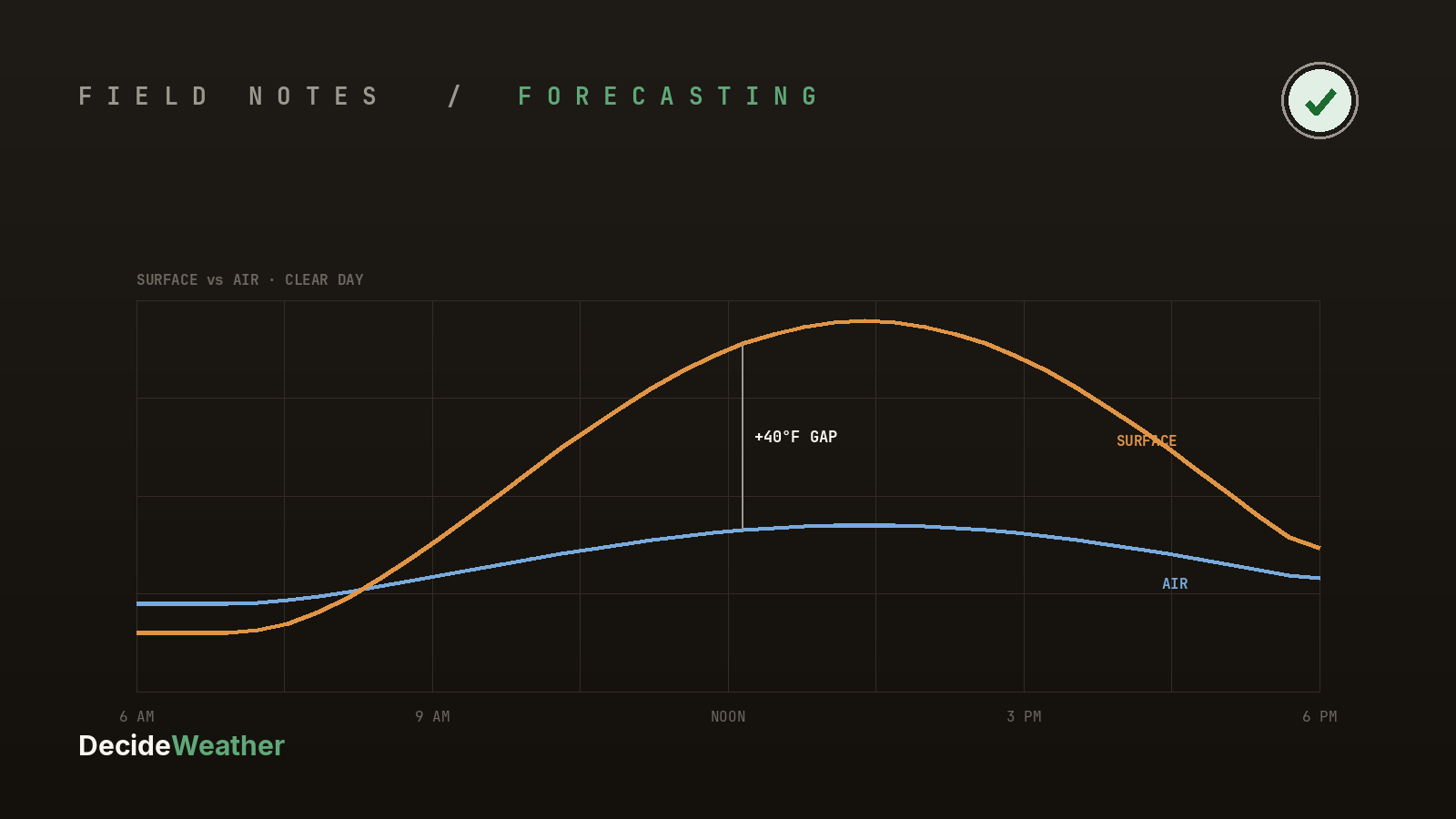
Run through the thresholds that actually decide outdoor work and a pattern shows up fast. Sealcoat needs pavement at 50°F. Paving is keyed to the surface you’re laying over. Shingles seal based on what the roof plane is doing. Frost forms on the grass. Ice bonds to the pavement. Concrete cares about the subgrade.
Now look at what a weather forecast gives you: air temperature, measured in shade, about two meters up, at a station that isn’t your site.
Nearly every threshold that matters is a surface threshold. Nearly every forecast is an air forecast. That gap is where a startling number of bad days come from.
How far apart they get
The divergence isn’t small. Asphalt in direct sun can run 30–50°F hotter than the air around it — which is why a 60°F morning can still be workable by midday, and why a shaded north-facing lot lags an exposed one a block away by hours.
It runs the other direction too. On a clear, calm night, surfaces radiate heat to the sky faster than the air cools, and pavement or turf can drop below air temperature. That’s the mechanism behind frost forming when the reported low never touched freezing — and behind ice bonding to a bridge deck while the thermometer says 34°F.
So the error isn’t a constant you can correct for with a rule of thumb. In sun it’s positive and large. At night it’s negative. The sign flips.
What actually drives it
- Solar load — direct sun is the biggest term by far, and it’s a function of sky cover, not just time of day
- Surface properties — dark asphalt, light concrete, and turf absorb and release heat completely differently
- Wind — mixes the boundary layer and pulls surface temperature back toward air temperature
- Thermal mass — a thick slab lags; a thin membrane tracks the air almost instantly
- Aspect and shade — the reason two sides of one building are two different job sites
None of that is exotic physics. It’s just none of it is in a forecast high.
Why we model it per site
This is the reason a regional forecast can be perfectly accurate and still give you the wrong call. It’s answering a different question than the one your threshold asks. The forecast says the air will be 52°F. Your spec asks about the pavement. Those are related, but they are not the same number, and on a sunny afternoon they aren’t close.
So we model surface temperature at the site — solar geometry, sky cover, surface type, wind, and the thermal behavior of the thing you’re actually working on — and then check that against the threshold that governs the work.
The forecast tells you what the day feels like. The surface tells you whether the work will hold. Every threshold worth respecting was written about the second one.