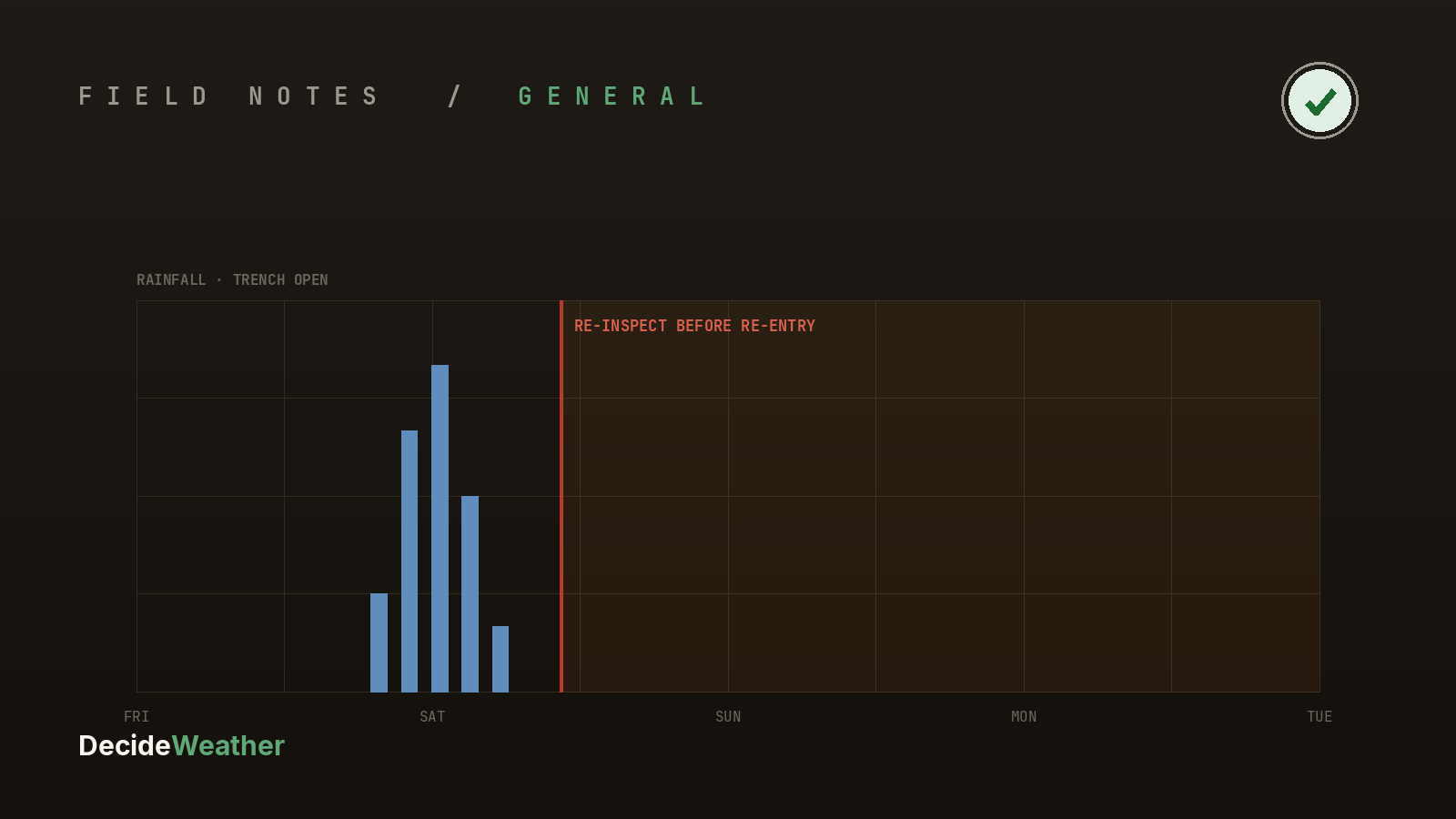
Most weather rules on a job site are about whether you can work today. Excavation is different. Rain doesn’t just stop the work — it changes the hole. The trench you protected correctly on Friday can be an illegal trench on Monday without anyone touching it.
The re-inspection isn’t optional
OSHA’s excavation standard requires that inspections be made after every rainstorm or other hazard-increasing occurrence, by a competent person, before anyone re-enters. Not a look from the edge. An inspection. And excavations subject to runoff from heavy rain get specific mention, because runoff does things to a trench wall that a rain gauge doesn’t capture.
The related rule is blunter: workers are prohibited from working in excavations with accumulated water unless specific precautions are taken. Water in the trench isn’t an inconvenience to pump out and forget. It’s a stop condition until the precautions are in place.
Rain can reclassify the soil under you
This is the part that catches crews, because it changes the math rather than just the schedule.
Soil classification determines your maximum allowable slope. Saturated or submerged soil is Type C — the most conservative class, with a maximum slope of 1.5H:1V. A trench sloped correctly for Type A or Type B soil, then soaked by a weekend of rain, may now be cut at an angle the standard no longer permits. Nothing about it looks different. The classification changed underneath it.
Previously disturbed soil can’t be classified as Type A at all, which means backfilled and re-excavated ground starts from a worse position before the rain even arrives.
The honest problem is that OSHA gives you the requirement without giving you a number. There’s no published rain rate or accumulation depth that defines “rainstorm.” That’s a real gap, and it’s exactly the kind of place where a defensible default beats a guess — a modest hourly rate, or an antecedent 24-hour total, as a trigger to prompt the inspection rather than leave it to memory.
Freeze-thaw counts too
Rain gets the attention, but frost and thaw cycling is a hazard-increasing occurrence on the same terms. A wall that froze solid overnight and thawed by mid-morning has lost strength it had when you left. In the Northeast that’s not an edge case — it’s most of the spring.
- Any rainstorm: competent-person inspection before re-entry, every time
- Standing water in the trench: stop until precautions are in place
- Heavy antecedent rain: assume the classification may have changed, not that it held
- Overnight freeze followed by a thaw: treat it as an occurrence, not as weather
The forecast question for excavation isn’t “can we dig today.” It’s “what happened to this hole since we last stood in it” — and that’s a question about the hours you weren’t there.