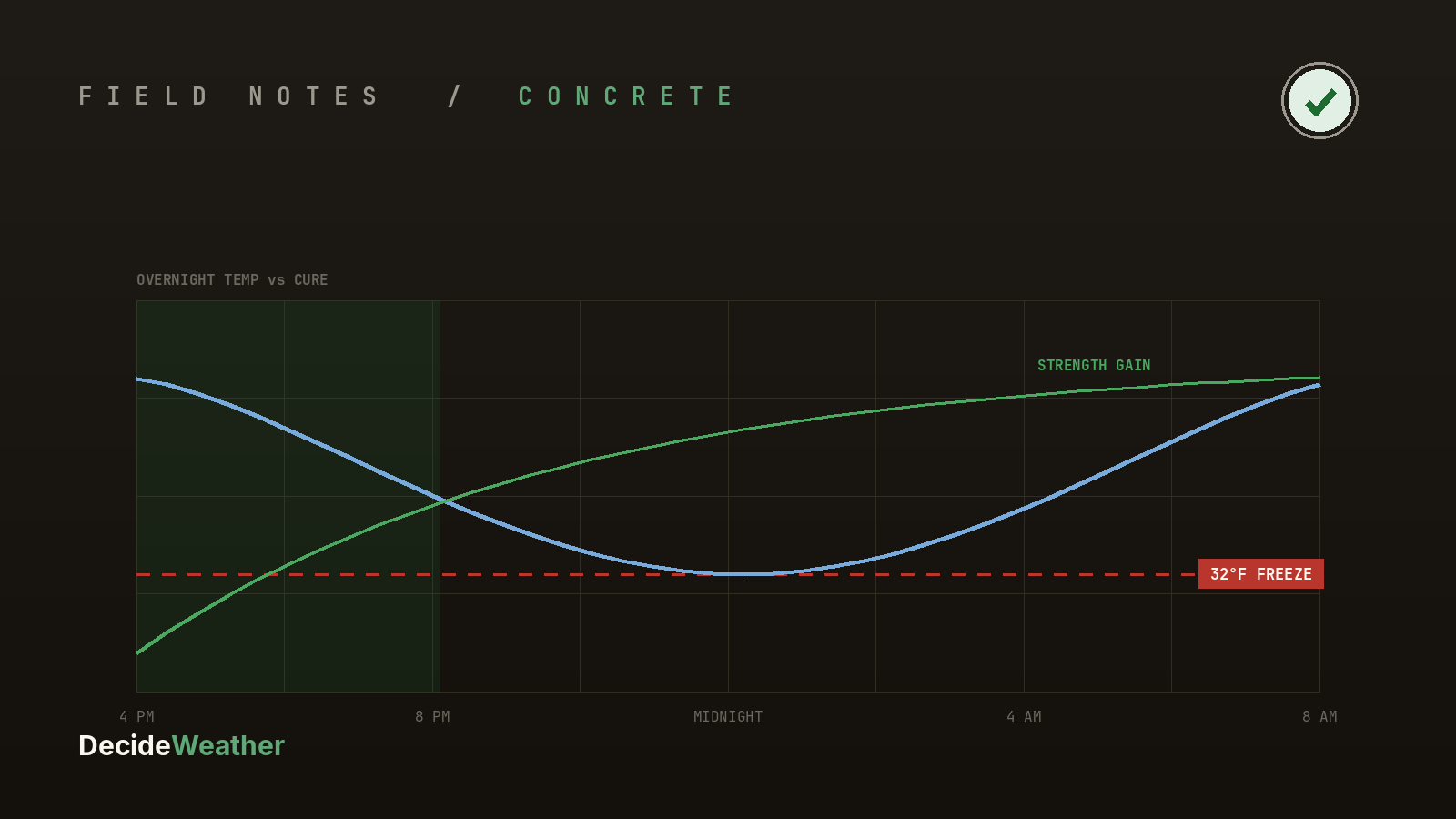
Hot-weather concrete gets all the attention — evaporation rate, plastic shrinkage, the race to finish. But cold weather is the one that fails quietly. The slab looks fine at dusk, freezes at 3 a.m., and you don’t find out what it cost you until the cylinders come back.
Why 500 psi is the number that matters
Fresh concrete is mostly water, and water expands when it freezes. Before the paste has developed enough strength to resist that expansion, a single freezing cycle can disrupt the matrix permanently — and the research behind the industry guidance puts the loss as high as half the design strength. It doesn’t heal. Warm weather the next day doesn’t fix it.
The threshold where concrete can survive one freeze without that damage is roughly 500 psi compressive strength. Everything about cold-weather practice — heated enclosures, insulating blankets, accelerators, heated mix water — exists to get the pour past that number before the first freeze reaches it.
The complication is that reaching 500 psi is itself temperature-dependent. Cold concrete gains strength slowly, so the colder it is, the longer you’re exposed and the longer you have to protect it. The problem compounds itself.
The trigger isn’t the forecast high
Cold-weather concrete provisions kick in when air temperature has fallen to — or is expected to fall to — around 40°F during the protection period. In New York, the state’s own spec is stricter, prohibiting placement below 45°F air without approval, and requiring the subgrade itself to be above freezing with no frost, snow, or standing water on it.
Notice what that trigger is actually keyed to: not the day’s high, and not the temperature at the moment the truck backs in. It’s the lowest temperature over the hours after you place. A 55°F afternoon that drops to 28°F overnight is a cold-weather pour, whatever the daytime number says.
That’s the miss we see most often. Crews check the forecast high, see something comfortable, and place — then the protection plan gets improvised at 6 p.m. when someone finally looks at the overnight low.
What the call actually depends on
- Overnight low across the full protection period, not the placement-hour temperature
- Subgrade and forms above freezing and free of frost, snow, or standing water
- Section thickness, which sets both the minimum placement temperature and how fast the slab loses heat
- How long you need protection — measured in days, not hours, and longer the colder it gets
The practical version: a cold-season pour is a multi-day commitment the moment the chute swings. We forecast the whole protection window — every hour of it — because the freeze that ruins the slab doesn’t happen while anyone is watching.