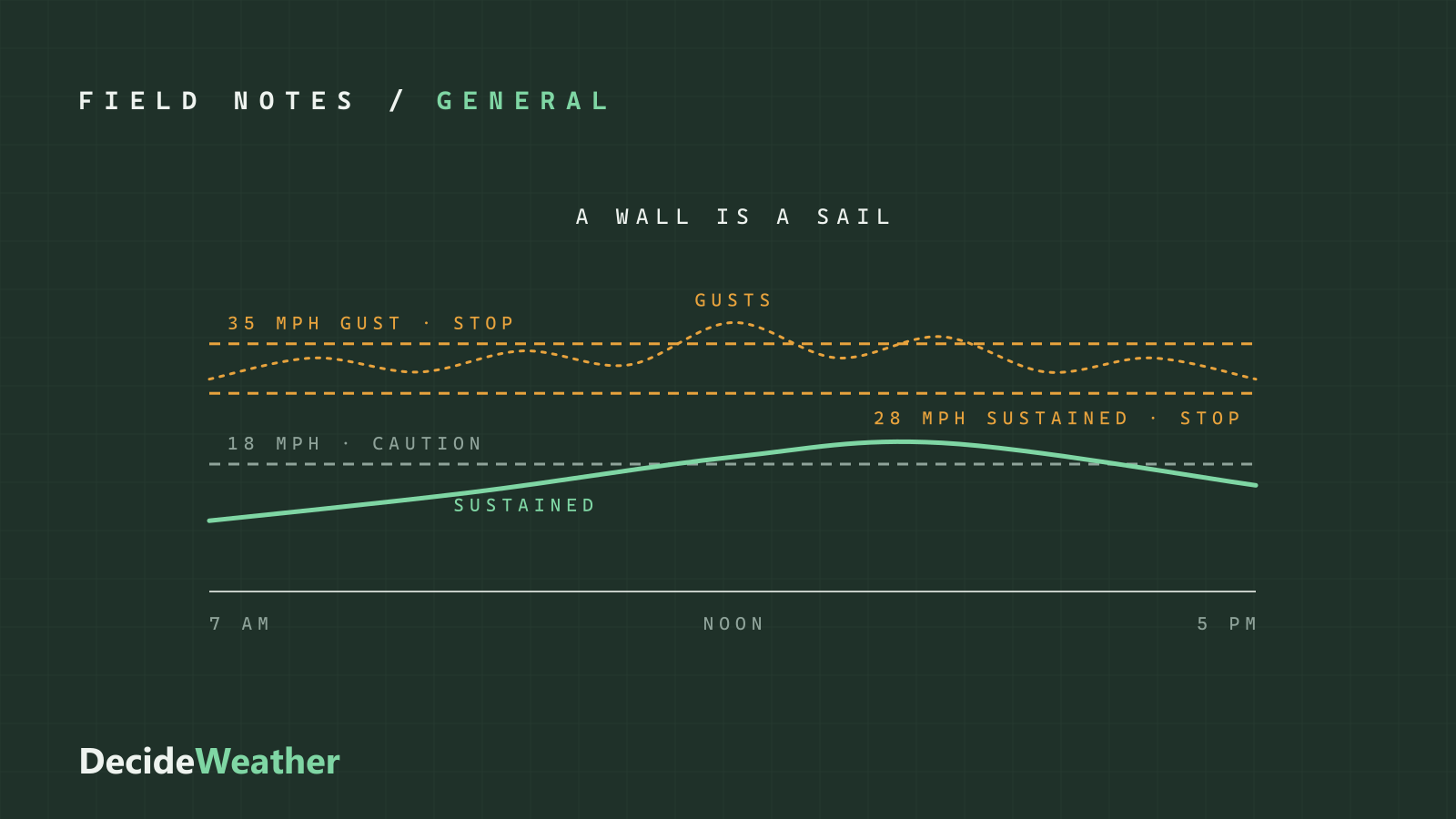
Framing has a moment that every carpenter respects: the wall goes up, the braces aren’t on yet, and the wind picks up. A sheathed wall is a sail. So is a sheet of OSB carried across the deck, and so is a roof truss swinging on the way up. Wind on a framing site is a force problem first and a comfort problem second.
Wind load grows with the square of speed
The standard engineering approximation for wind pressure is 0.00256 × V², in pounds per square foot with wind speed in mph. Squared matters: doubling the wind speed quadruples the force.
On one 4×8 sheet, which is 32 square feet:
- 20 mph: about 1 psf, roughly 33 lb of push.
- 30 mph: about 2.3 psf, roughly 74 lb.
- 40 mph: about 4.1 psf, roughly 131 lb.
That’s one panel. A 16-foot sheathed wall section presents several hundred square feet to the wind, and until it’s braced, nothing but the crew is holding it. A worker carrying a sheet across an open deck in 35 mph gusts is holding a force that can pull them off their feet, or off the edge.
Gusts, not averages
A forecast of “15 mph wind” is a sustained average. The gust is the jump, and on fall days behind a cold front, gusts can run well above the sustained speed. We’ve covered this for roofing crews, and framing has the same rule: you brace for the average, but gusts cause the accidents.
- A wall that can stand in steady 20 mph wind can go over in a 35 mph gust before the braces are on.
- A sheet handled at a roof edge is most dangerous during a gust, because it’s sudden.
- Variable, gusty days are harder than steady windy days, because nobody gets a feel for the load.
What the rules say, and what they don’t
There’s no single OSHA wind-speed limit for framing. The closest direct rule is for scaffolds: no work on scaffolds during storms or high winds unless a competent person decides it’s safe and workers are protected by fall protection or a windscreen, and then the scaffold must be secured against the wind. Aerial lifts have their own manufacturer limits, commonly 28 mph. For raising walls and handling sheet goods, the line is company policy and the competent person’s call. Many crews stop that work when sustained wind reaches the mid-20s or gusts reach the mid-30s.
The most useful rule is simpler: brace before the wind, not during it. Temporary bracing on every standing wall at the end of each day, and before any forecast wind event, costs little. Rebuilding a collapsed wall costs a lot more.
Wind by the hour
DecideWeather’s Above Ground operation, which covers framing, sheathing, and other work on the structure, reads wind in both of the ways that matter:
- Caution: sustained wind from 18 to 28 mph, or gusts from 25 to 35 mph.
- Stop: sustained wind above 28 mph, or gusts above 35 mph.
Because an unfinished structure spends the night exposed, Work Windows splits a multi-day Above Ground window when a Stop falls overnight. A three-day framing stretch with a windy night in the middle shows up as two separate windows. When you book the work in Scheduled Jobs, you get a push if the weather changes that job’s workable hours. A typical one reads: “Weather cuts Thursday’s job short.” You’d rather hear that on Tuesday than Thursday morning.