Ask around a job site what the wind limit is for a lift and you’ll get a confident answer. Ask where it comes from and the confidence usually evaporates. Wind rules are one of the most misquoted areas in construction safety — and the gap between what people believe and what actually binds is worth knowing, because one of them is enforceable.
The number that’s real: 28 mph
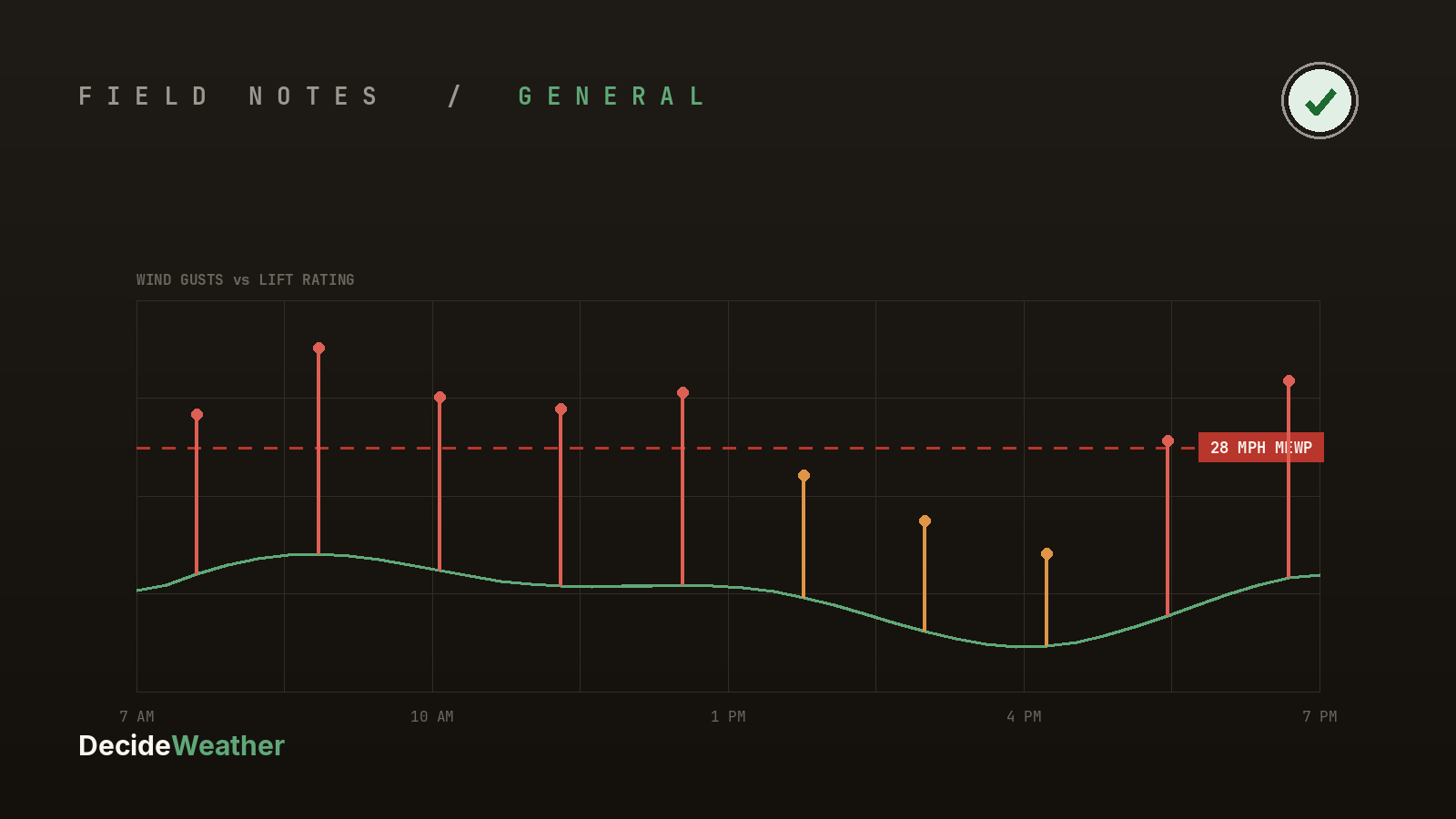
Outdoor-rated mobile elevating work platforms are built and tested to a wind rating, and the industry converges on 12.5 m/s — 28 mph as the maximum. JLG states it directly: don’t operate the machine when wind exceeds 28 mph. Genie says the platform must not be raised when wind speeds may exceed the same figure. ANSI/SAIA A92.20 standardizes it across wind-rated machines.
The detail that gets missed: indoor-rated machines are rated for zero wind. Not “less wind.” Zero. A machine designed for an interior slab, rolled outside for one quick task on a breezy day, is operating outside its rating from the moment it leaves the building. That’s not a technicality — it’s the whole basis of its stability calculation.
The number that isn’t what people think: 20 mph
Here’s the one worth correcting. OSHA does not mandate 20 mph as a general crane operating limit. The only OSHA-mandated numeric wind threshold for cranes applies to hoisting personnel: when wind exceeds 20 mph at the personnel platform, a qualified person must determine whether the lift is safe, and if it isn’t, it doesn’t begin — or it terminates.
That’s a specific rule about a specific operation. It’s been repeated so widely as “OSHA says 20 mph for cranes” that most crews believe it’s general. It isn’t.
What actually binds general crane operation is the manufacturer’s load chart, made enforceable through the requirement that a competent person adjust equipment and operations for the effect of wind, ice, and snow on stability and rated capacity. So the limit is real and legally meaningful — it just lives in the chart for your machine, not in a number someone remembered.
Gusts, not averages
Notice the personnel-hoisting rule specifies sustained or gusts. That’s deliberate. A lift is a lever with a platform at the end, and it’s the gust that moves it — the same reason gusts, not averages, drive the call on a roof.
- Outdoor-rated MEWP: 28 mph is the stop, and it’s a gust number
- Indoor-rated machine outdoors: any wind exceeds the rating
- Personnel hoisting by crane: 20 mph at the platform triggers a qualified-person determination
- General crane work: the load chart is the limit — know yours
- Cold operations: below about 10°F, hydraulics and derating deserve a look
The useful forecast for lift work is peak gust through your working hours at that site — because “the wind is fine” and “the wind stayed under the rating all afternoon” are different claims, and only one of them is checkable.