Of every weather hazard a roofing crew faces, lightning is the one that turns a productive afternoon into a full stop in seconds. A roof is the highest, most exposed surface on most job sites, your crew is standing on it, and a metal seam, a wet membrane, or a steel deck makes an attractive path to ground. The good news: lightning is also one of the most predictable hazards to manage — if you know the rule, the distances, and the timing. This is how we think about lightning safety for outdoor crews, and how a weather window app helps you make the call instead of guessing.
Why a roof is the worst place to be in a storm
Lightning seeks the path of least resistance to the ground, and elevation matters. A worker on a two-story roof is, quite literally, closer to the cloud and standing above the surrounding terrain. Add conductive materials — standing seam metal, copper flashing, wet underlayment, scaffolding, and aluminum ladders — and you’ve assembled exactly the kind of target lightning safety guidance warns about. Side flashes and ground current can injure a worker who never takes a direct hit. The only reliable protection is to not be on the roof when a storm is within range.
The 30-30 rule, explained for the field
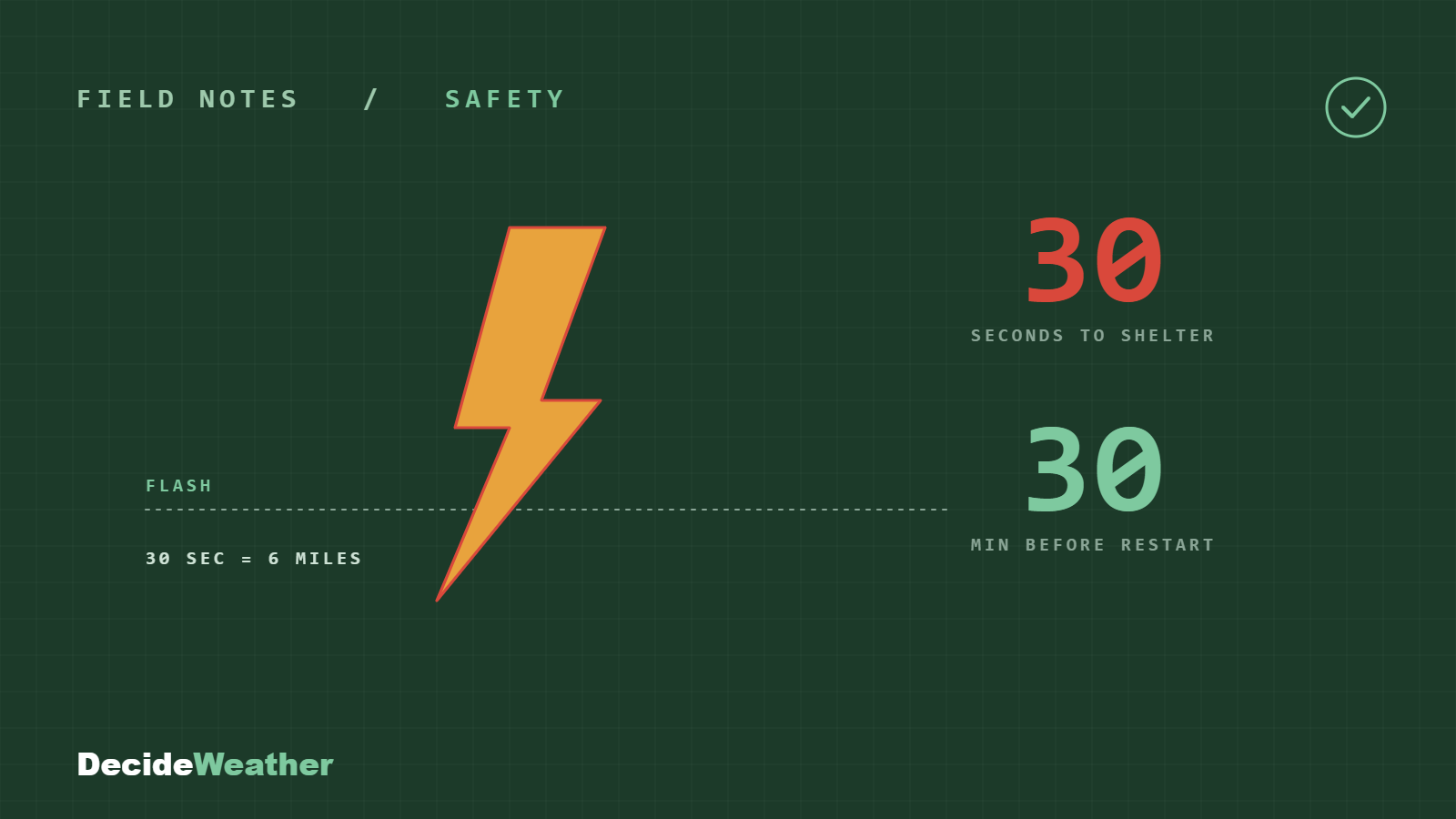
The National Weather Service’s 30-30 rule is the simplest field tool for lightning safety, and it has two halves:
- The first 30 — flash to bang. When you see lightning, start counting. If you hear thunder in 30 seconds or less, the storm is roughly six miles away or closer — well inside strike range. That’s your signal to get off the roof and into a safe shelter immediately.
- The second 30 — the all-clear. After the last clap of thunder, wait a full 30 minutes before sending anyone back up. Most lightning casualties happen before the rain starts or after it seems to have passed, because crews go back too early.
Sound travels about a mile every five seconds, so the flash-to-bang count is a rough rangefinder you can do without any equipment. But it has a blind spot: by the time you can count a strike at six miles, the next strike could already be on top of you. Lightning regularly jumps 10 miles or more from a storm — the so-called “bolt from the blue.” That’s why the second 30 — the 30-minute wait — is non-negotiable, and why crews that rely only on what they can see and hear get caught.
What a safe shelter actually is
“Get to shelter” doesn’t mean a job trailer awning or standing under a tree. A genuinely safe shelter during a lightning storm is:
- A fully enclosed building with wiring and plumbing — a finished structure, not a frame.
- A hard-topped vehicle with the windows up. The metal shell, not the rubber tires, is what protects you by routing current around the occupants.
Open structures, picnic shelters, dugouts, scaffolding, and the lee of a wall are not safe. Once a storm is in range, the time to relocate is now, not when the rain hits.
Where forecasting beats reacting
The 30-30 rule is a reactive tool — it tells you the storm is already here. The real advantage on a job site is anticipating it, so you can plan the day’s high-exposure work around the threat instead of scrambling crews off a roof mid-task. That’s the gap a weather window app fills.
For lightning specifically, the signals worth watching ahead of time are:
- Convective timing — when does the atmosphere become unstable enough for thunderstorms to fire? Afternoon heating in summer often pushes storm initiation into the same window you’d schedule tear-off or hot work.
- Storm motion and arrival — not just “storms today,” but when the leading edge actually reaches your address versus the metro forecast.
- Lightning probability, not just rain — a cell can be electrically active well before it produces measurable rain over your site.
- The clearing behind the line — when the threat genuinely ends, so you know whether restarting after the 30-minute wait is worth it or whether you’re done for the day.
Building lightning into the work-window call
In DecideWeather, thunderstorm and lightning risk feed the same Go / Caution / Stop recommendation as wind, precipitation, and surface conditions — tuned to roofing. The point isn’t to replace the 30-30 rule; it’s to give a superintendent enough lead time to sequence the day so the crew isn’t on the deck when the storm arrives in the first place. Schedule the exposed work into the clear morning window, plan the indoor or ground-level tasks for the unstable afternoon, and keep the 30-30 rule as the hard backstop.
Lightning doesn’t negotiate, and it doesn’t give second chances. Treat the 30-30 rule as the floor for crew safety, forecast the threat so you’re never reacting blind, and never let the pressure of a deadline put a worker on a roof with a storm in range. A day lost to a delay is recoverable. The alternative is not.