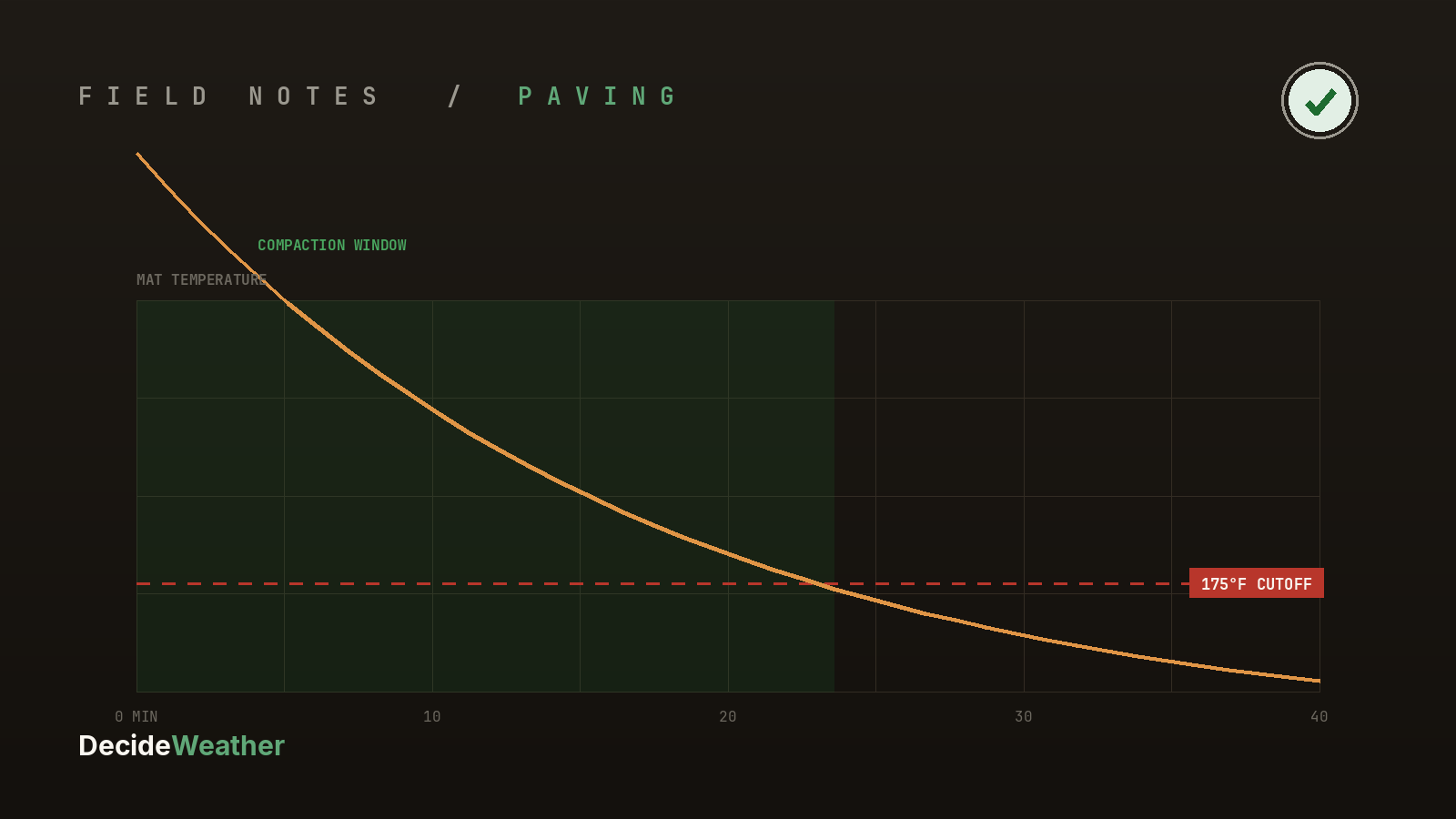
Hot mix has one non-negotiable rule: you compact it while it’s hot, or you don’t compact it at all. The mat has to reach density before it cools to about 175°F, after which the roller is just making noise. Everything else in a paving day — the minimum temperature specs, the wind, the lift thickness — is really an argument about how many minutes you have.
Why the state minimums aren’t the whole answer
Most state DOTs publish minimum surface temperatures keyed to lift thickness. NYSDOT works off a surface-temperature table; PennDOT sets 40°F and rising for wearing and binder, 35°F for base. The pattern across NAPA and the Asphalt Institute is consistent: roughly 50°F for a thin top course, 45°F mid-range, 40°F for base and binder.
Those numbers are real hard floors and you have to respect them. But they’re also blunt. They’ll tell you a 52°F day is legal for a thin lift. They won’t tell you that with a 15 mph wind, that same mat gives you a fraction of the working time you had on a calm day at the same temperature — because a thin lift has almost no thermal mass to lose.
What actually sets the clock
The methodology that reconciles all of it is cooling-time analysis — the approach behind PaveCool, developed by MnDOT and adopted broadly across the industry. It takes the variables that actually govern heat loss:
- Lift thickness — the single biggest factor; thin lifts cool dramatically faster
- Mix delivery temperature — where the clock starts
- Surface temperature of what you’re paving over — a cold base pulls heat straight down
- Wind speed — convective loss off the top of the mat
- Sky cover, time of day, latitude — solar gain, or its absence
Output is a single useful number: minutes until the mat hits 175°F. That’s your compaction window. Not the day’s high, not whether the spec allows it — minutes.
Where days go wrong
The classic failure isn’t paving on an illegal day. It’s paving on a legal day with a roller train sized for a longer window than you actually had. Cold base, thin lift, breezy afternoon: the clock can compress enough that the back of the mat is below cutoff before the breakdown roller gets there.
- Any active rain: stop — this one isn’t a judgment call
- Wet surface: stop, even after the rain ends
- Wind rising through the afternoon: the window shortens as the day goes on, not just as it cools
- Thin lift on a cold base: the tightest clock you’ll ever run
The seasonal calendars matter here too. NYSDOT and MassDOT both put hard date limits on top-course placement, and those are contractual, not meteorological — but they exist because late-season days are exactly when the cooling clock runs shortest.
The forecast tells you the temperature. What you need is the number of minutes between the screed and the cutoff, on this lift, at this site, in this wind. That’s the call we model.