It’s late October. The forecast high is 47°F, the ready-mix truck is booked for 8 a.m., and the question comes up on every cold-season pour: is it too cold to pour concrete? The honest answer has two parts, and most people only check one of them.
Part one: the temperature at the pour
Concrete gains strength through hydration, a chemical reaction between cement and water that slows as the temperature drops. The colder the concrete, the slower everything happens:
- Set time stretches. Finishing waits longer, and the slab is vulnerable to rain and freezing for more hours.
- Early strength gain slows. A mix that reaches handling strength in a day at 70°F can take several days in the 40s.
- Near freezing, hydration nearly stops. Concrete that freezes while its water is still free to expand can be permanently damaged.
That’s why ACI 306, the cold-weather concreting guide, defines cold weather as air temperature at or below 40°F, or expected to fall there during the protection period. Once you’re in that range, the pour needs a plan: heated water and aggregates, accelerators, insulated forms, blankets, or enclosures and heat.
ACI 306 also recommends minimum concrete temperatures at placement by section size, around 55°F for sections thinner than 12 inches, and lower for massive sections. The ready-mix producer can heat the mix to meet that. The job site has to keep the heat in.
Part two: the next 12 hours
The second part is where fall slabs get ruined. The pour-time temperature can pass while the night behind it fails. A 50°F afternoon pour with a 27°F night is a freeze risk to a slab only hours old. We wrote about this trap: the pour looks fine and the damage happens at 3 a.m.
The working line is 500 psi. Concrete that freezes before reaching about 500 psi can lose a large share of its strength permanently. Getting there takes about a day in mild weather and longer in the cold, so the protection plan has to cover the whole time until the slab reaches it.
And under all of it: the ground has to be thawed. A slab on frozen subgrade settles when the ground thaws, whatever the air temperature was.
A simple checklist for cold-season pours
- Placement air temperature: under 40°F means cold-weather procedures. From 40°F to 45°F, expect slow set and plan for it.
- Forecast low in the next 12 hours: at or below freezing means blankets or enclosures staged before the pour, not after. From 32°F to 40°F, have protection ready.
- Subgrade: not frozen, no frost in the base.
- Mix: discuss hot water, accelerators, and delivered temperature with the producer the day before.
Both halves at once
DecideWeather’s Pour operation checks both halves of the question for every hour:
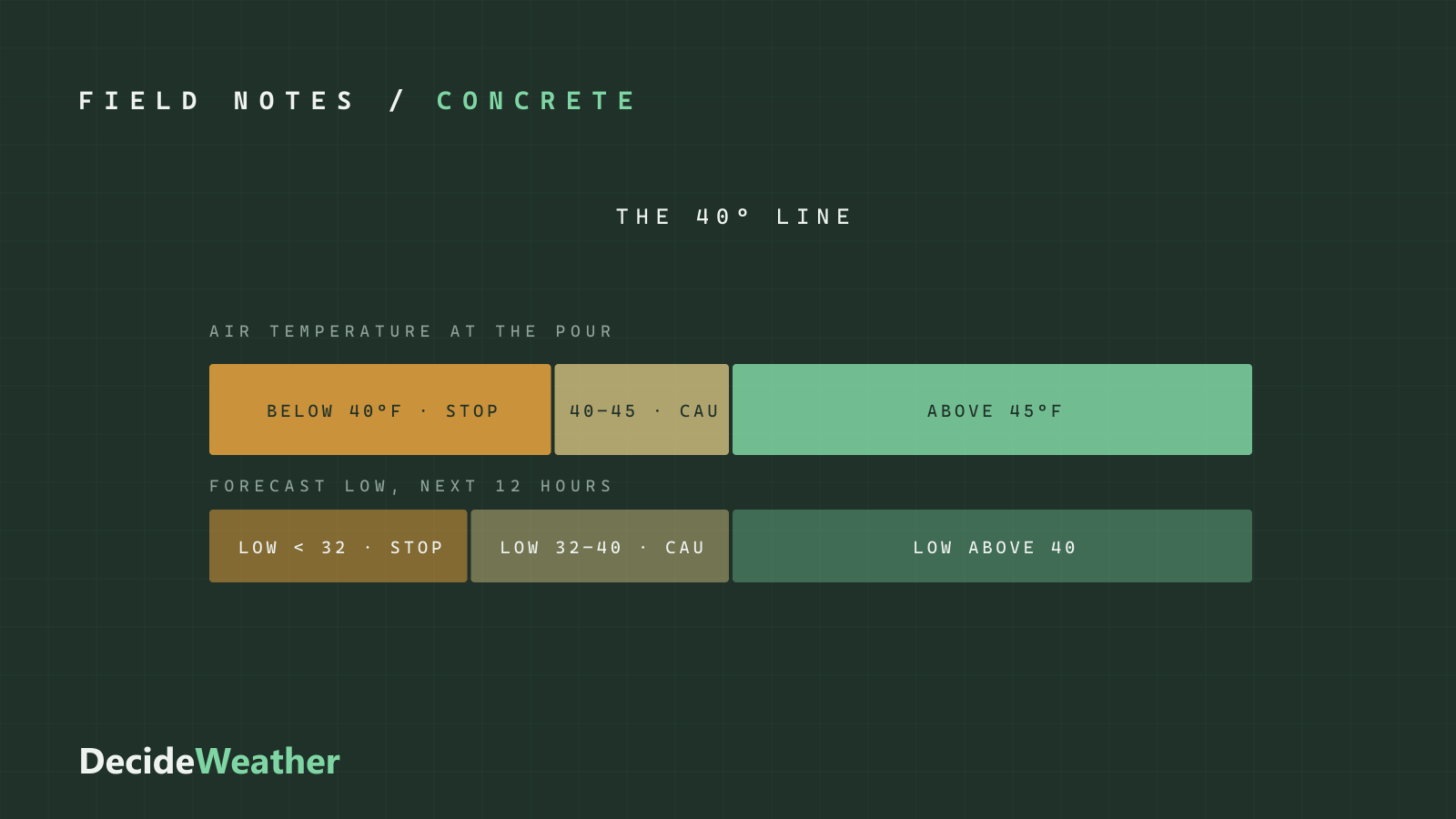
- Pour-time temperature: air below 40°F is a Stop, and 40°F to 45°F is a Caution.
- The next 12 hours: a forecast low below 32°F is a Stop, and a low from 32°F to 40°F is a Caution.
- The ground: frozen soil near the surface is a Stop.
When the freeze is the problem, the recommendation says when it arrives as a clock time, for example “tomorrow around 4am”, so the protection plan has a deadline.
For multi-day work, Scheduled Jobs keeps watching the days you’ve booked and sends a push when the weather changes their workable hours, including when a cold night moves into the forecast after you scheduled the pour.