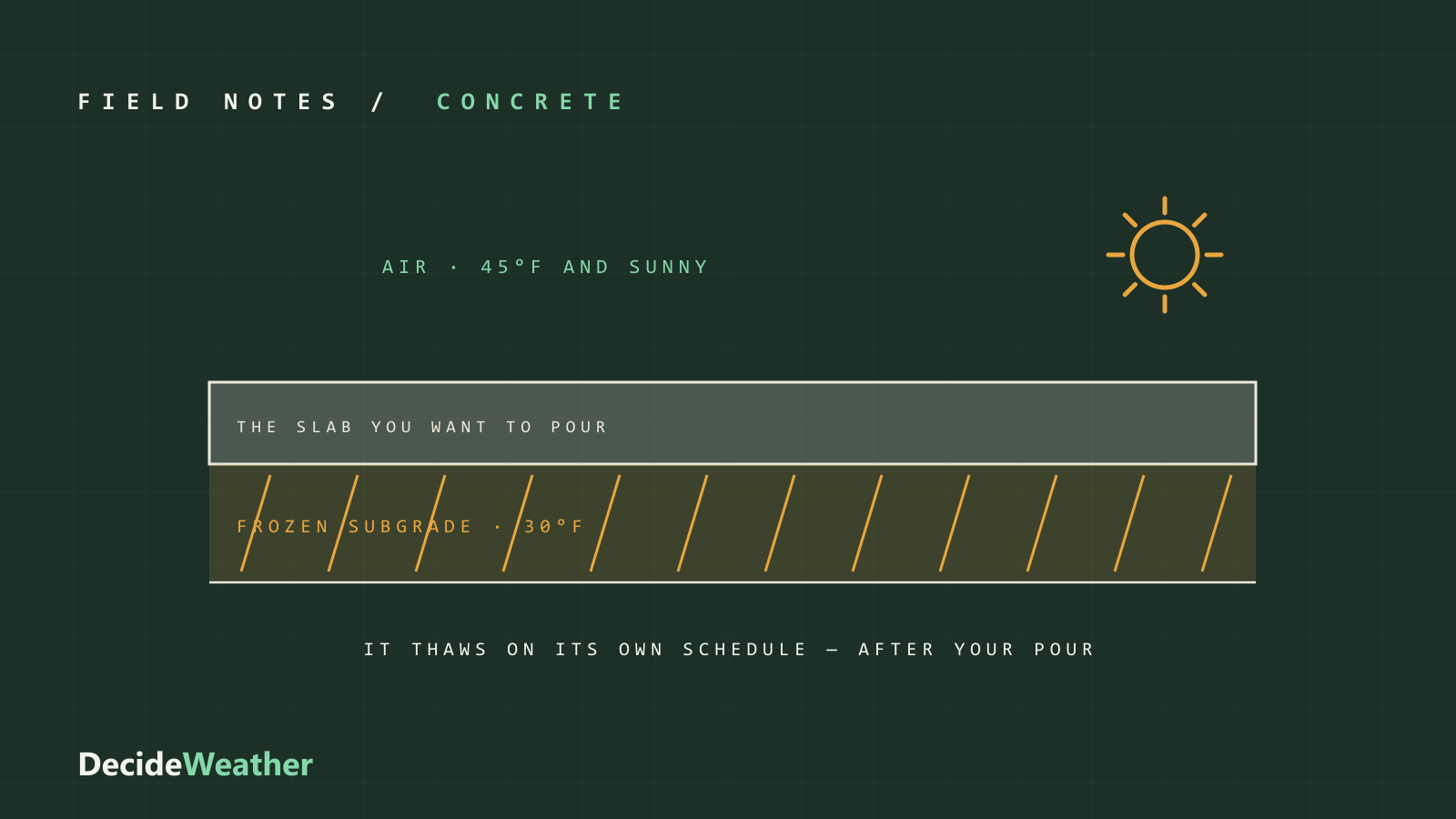
Late in the season, concrete has two ways to freeze: from above, in its first night — and from below, before the truck ever arrives. The second one gets less attention because nothing about it is visible from the driver’s seat. The forms are set, the sun is out, the air is 45°F and climbing — and four inches down, the subgrade is a frozen shelf that will not hold its shape past the next warm spell.
Frozen ground is borrowed bearing
A slab on grade is only as good as what it bears on, and frozen soil is bearing on loan. Two things change when it thaws. First, frost heave reverses: water in the soil expanded as ice lenses and lifted the grade — sometimes fractions of an inch, sometimes more — and the thaw gives it all back, unevenly. Second, thawing soil is briefly at its weakest: the melting ice releases water into a soil that hasn’t drained yet, so the subgrade goes from rigid to soft exactly once, right after your pour.
Concrete placed on that surface cures to the shape of ground that’s about to leave. Settlement cracks, tilted slabs, hollow-sounding corners — the classic spring signature of a late-fall pour that beat the thermometer and lost to the dirt. ACI 306 is unambiguous on the fix: frozen subgrade gets thawed before placement, with ground heaters and insulation, or the pour waits.
The air lies about the ground
The trap is that soil runs on a lagged clock — the same lag that drives spring scheduling from the other side. Soil temperature trails air temperature by days, in both directions:
- After the first hard-freeze stretch, the top inches of ground can stay frozen through several mild sunny days. The 50°F afternoon that feels like a pour day is sitting on Tuesday’s cold.
- Early in the season, one sharp night usually hasn’t frozen the subgrade — soil holds fall warmth long after the first white mornings, and a probe often clears a pour the air temperature would spook you out of.
Both errors are expensive in opposite directions: one pours on frost, the other burns good late-season days. The cure for both is the same — read the ground itself. Probe the subgrade inside the forms, not the lawn at the edge; look for lens ice, not just crust; and treat shaded and north-side sections as their own answer, because they freeze first and thaw last.
The late-season pour checklist
- Probe the actual subgrade the morning of, a few inches down, in more than one spot
- Weight recent nights over the current afternoon — a string of hard freezes means frost until proven otherwise
- Thaw deliberately if you must pour — heaters and insulation ahead of time, per ACI 306; never place over frost
- Then check the night ahead — ground clear, overnight low next; late fall makes you win both
DecideWeather reads shallow soil temperature directly at each site — the top layer a slab actually bears on — and holds the pour recommendation when that layer sits at freezing, independent of what the air is doing. It’s the difference between a forecast for the sky and a forecast for the thing you’re building on.