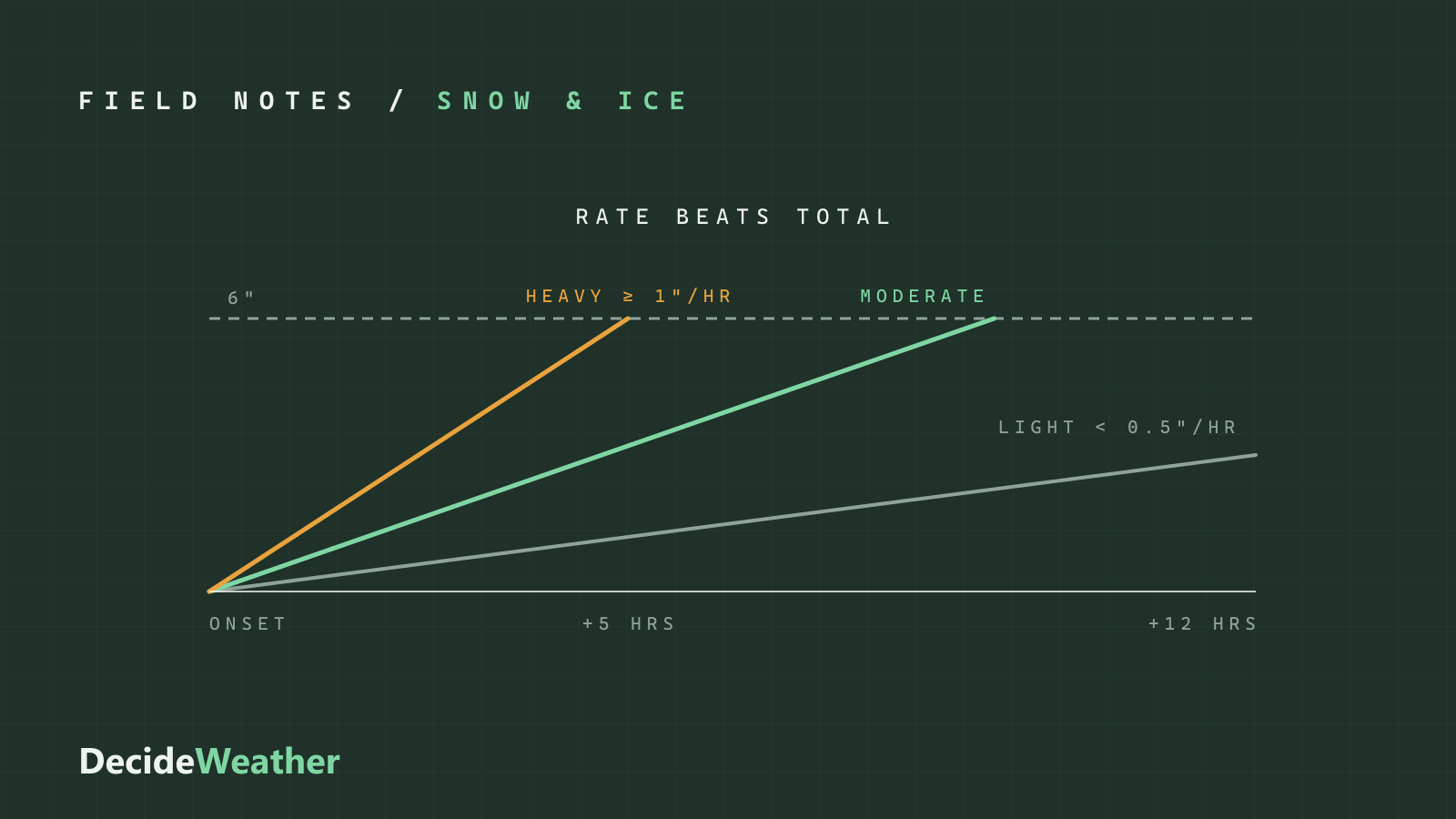
“Six inches overnight.” That’s what most people hear in a snow forecast. It tells you how much work there is, but not how fast it arrives. Six inches over twelve hours and six inches in four hours are different operations, and the difference is the snowfall rate.
The rate tiers
Snowfall rate is usually described in three tiers:
- Light: under half an inch per hour. Steady, manageable, and de-icers can often keep up on treated surfaces.
- Moderate: half an inch to an inch per hour. Plowing becomes the main tool, and cycle times start to matter.
- Heavy: an inch per hour or more. Visibility drops, snow builds up faster than trucks can cycle, and de-icers can’t keep pavement clear.
Intense bands, lake-effect snow, and snow squalls can briefly produce 2–3 inches per hour. That’s when “we’ll get to it” turns into a lot that’s impassable an hour later.
Rate sets the cycle time
Your trigger depth sets how much snow triggers a pass. The rate sets how often that happens:
- At half an inch per hour with a 2-inch trigger, the lot needs a pass about every four hours.
- At an inch per hour, about every two hours.
- At 2 inches per hour, every hour, which few routes can deliver.
So route design comes down to one comparison: cycle time (how long before a truck gets back to a given lot) against time to trigger (how long before that lot is past its trigger depth again). When heavy snow shortens time to trigger, routes built for moderate snow fall behind, and every lot on the route ends up with more snow than it should.
Why salt loses in heavy snow
Salt works by turning into brine, and brine that keeps getting diluted by fresh snow gets weaker until it stops melting. At heavy rates:
- Salt on top of accumulating snow mostly prevents bonding at the pavement. That’s still useful, because it makes the next pass scrape clean.
- It won’t keep the surface clear until the rate drops.
- The efficient move is usually plow during the heavy period, salt after, when the rate falls and a treatment can actually finish.
Planning from the storm shape
DecideWeather shows each snow storm as an event on the Job Site card, with two things side by side:
- The rate: light under half an inch per hour, moderate from half an inch to an inch, heavy at an inch or more.
- The total: shown as a range, not a single number, and labeled from Low (1–4 inches) to Extreme (16 inches or more).
The Plow Now phase starts when forecast accumulation crosses your trigger and runs until two hours after the storm ends. A heavy storm opens it hours sooner than a slow one with the same total, which tells dispatch when trucks really need to roll.
For the big ones, Alerts sends an Extreme Weather heads-up 12 to 72 hours out when a storm forecast at a foot or more enters a site’s forecast. That’s time to line up subcontractors, stock material, and set shifts for a long night.