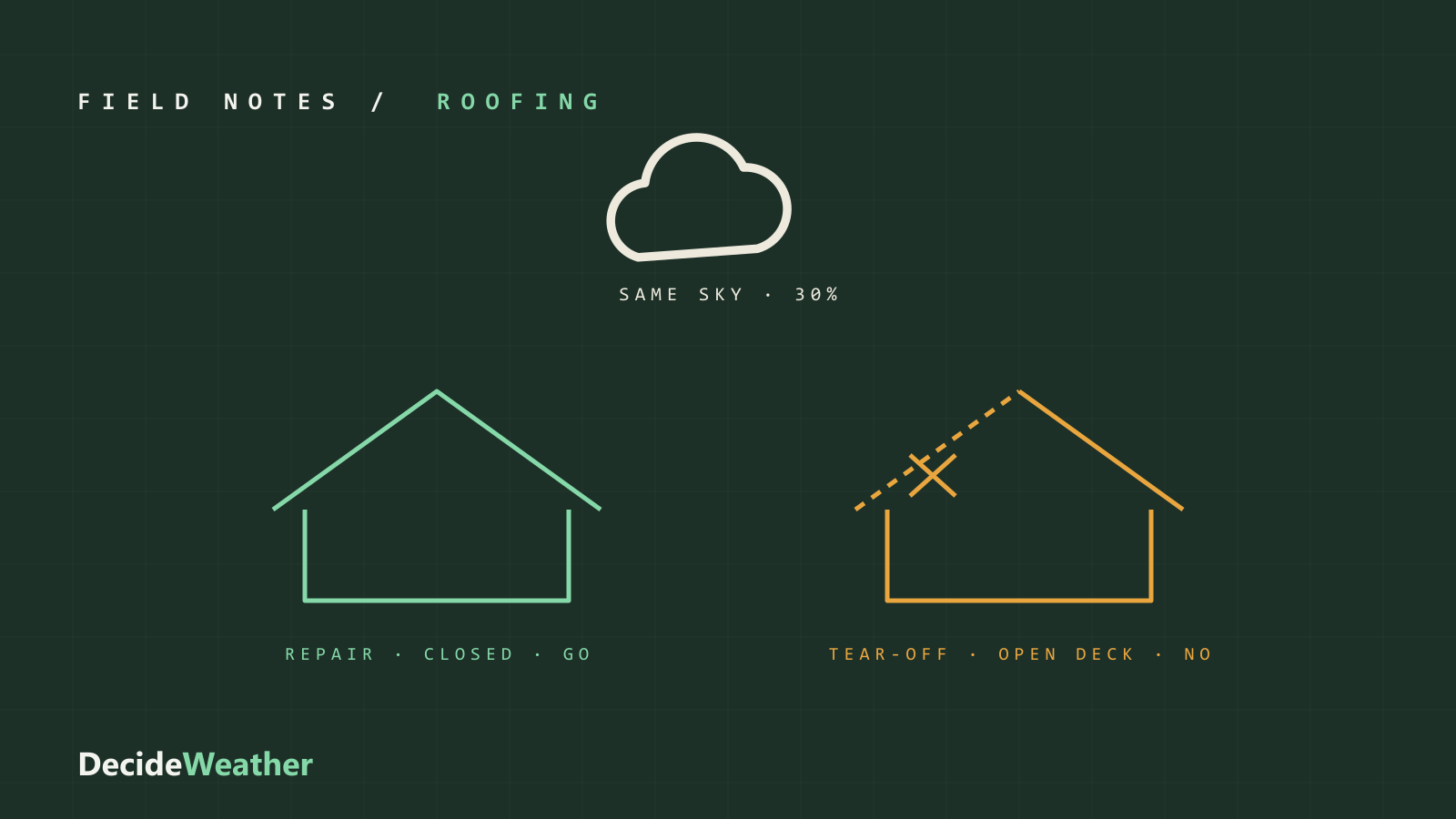
Two crews, one company, one Tuesday. The repair crew patches flashing all day under a gray sky that spits twice. The tear-off crew never leaves the shop. Nobody got the forecast wrong — the jobs just carry different exposure, and exposure, not the sky, is what a roofing rain call actually prices.
The asymmetry: closed roof, open roof
A repair happens on a building that stays weather-tight around the work. If a shower moves through, the crew pauses, the materials go under cover, and the building shrugs. The cost of surprise rain is minutes.
A tear-off removes the weather barrier on purpose. From the first course stripped until dry-in, the building’s interior is betting on the sky. Rain onto exposed decking soaks sheathing, wets insulation, stains ceilings, and can walk a roofing job into an interior-restoration claim. The cost of surprise rain is measured in change orders — which is why the tolerance isn’t “a bit lower” than a repair’s. It’s a different category.
This is the general shape of good weather calls: price the downside, not just the probability. A 40% chance is the same number over both jobs; multiplied by each job’s consequence, it’s a shrug on one and a stop on the other.
Running the tear-off call
The tear-off decision has its own arithmetic, and it isn’t the daily forecast:
- The exposure window is what you’re insuring. Not the whole day — the hours between opening the deck and dry-in. Rain at 4 p.m. is irrelevant if you’re papered-in by 1. That turns the question into strip time plus dry-in time versus arrival time, which is a schedule problem you control.
- Open only what you can close. Section the job to the sky you have. A marginal day can still be a productive tear-off day at half-roof scale.
- Light rain is not “basically dry.” Even a passing shower wets the deck and everything adhesive downstream of it — and a wet deck is a footing problem before it’s a bonding one.
- The gray zone belongs to repairs. Days too risky to open a roof are exactly the days to burn down the repair backlog. The asymmetry is a scheduling asset if the book is sorted to use it.
What this looks like in a recommendation
A weather answer for roofing has to know which job it’s answering for. The same hour — light rain possible, a couple tenths in the afternoon band — legitimately reads workable, watch the sky for a repair crew and don’t open the deck for an install. Collapse the two and the answer is wrong for somebody every marginal day of the season.
DecideWeather keeps them separate: install/tear-off and repair each carry their own recommendation, with the install thresholds set tighter precisely because the open deck can’t absorb what a closed roof can. On the borderline days — which is most of the days that matter — the two operations genuinely diverge, and that divergence is the schedule.