An asphalt shingle roof isn’t finished when the last nail goes in. It’s finished when the seal strips activate and every course bonds to the one below it. In warm weather that happens on its own within days and nobody thinks about it. In cold weather it may not happen at all — and the roof looks completely normal until the wind finds it.
What the seal strip actually needs
The adhesive strip on a shingle is thermally activated. It needs sun and warmth to soften, flow, and bond. Below roughly 40°F, it stays stiff, the courses sit loose, and the roof’s wind resistance — the thing the warranty is built on — simply isn’t there yet.
Worth being precise about where that number comes from: NRCA doesn’t publish a cold-weather temperature guideline for shingle installation. The 40°F figure is the practical floor that the major manufacturers converge on independently — GAF, CertainTeed, Owens Corning, IKO and others all land in the same place. It’s a manufacturer floor, not a code minimum, and it’s usually tied to the warranty rather than to any legal requirement.
The related number people mix up is 45°F, which typically comes from leak barrier and ice-and-water shield application — a different product with its own adhesion requirement, not the shingles themselves.
Hand-sealing is a fix, not a workaround
Manufacturers do allow cold-weather installation with hand-sealing: a manual dab of approved asphalt cement under each tab. It works. It also roughly doubles the labor on the field, and it has to be done correctly and consistently, because a partially hand-sealed roof has a defined weak line rather than a general weakness.
What hand-sealing doesn’t do is make cold weather irrelevant. Shingles get brittle when cold — they crack when bent, and the nail gun drives differently. The handling problems are real and separate from the sealing problem.
The window, not the day
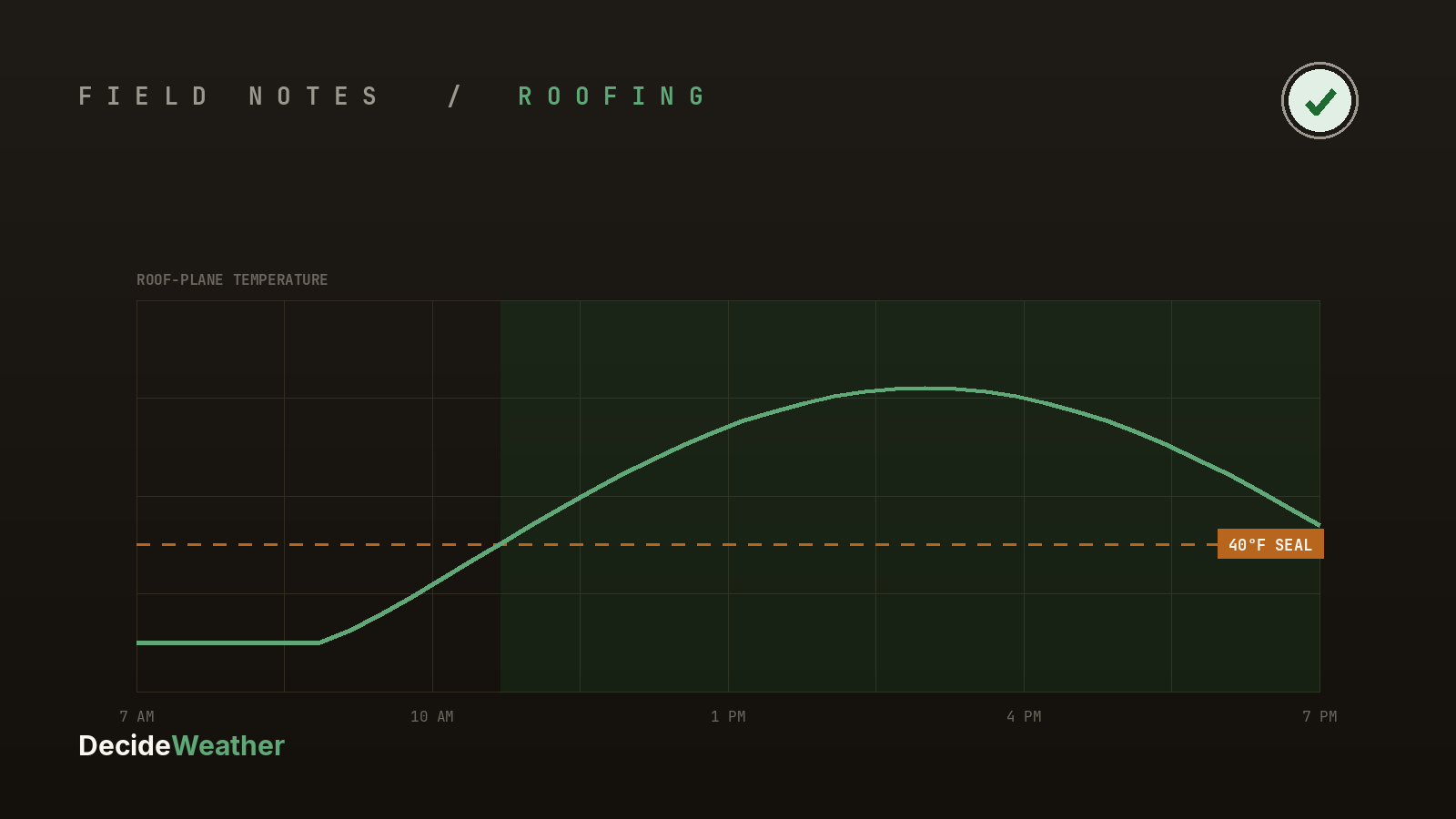
The useful question is rarely “is today above 40?” It’s whether there’s enough warmth on the roof plane in the hours you’re working, and whether the deck will see enough sun in the days after to finish the bond.
- Below 40°F all day: hand-seal or reschedule — a nailed-but-unsealed roof is an exposure
- Cold morning, mild afternoon: a real window, tighter than the daily high suggests
- Frost on the deck: stop, regardless of air temperature — footing first
- Cold plus a wind event coming: the worst combination, because the seal won’t be set when it hits
Air temperature is a proxy for what the shingle actually experiences. We model the roof plane — sun exposure, surface temperature, the hours that count — because 41°F in the shade and 41°F in full sun are two different roofs.