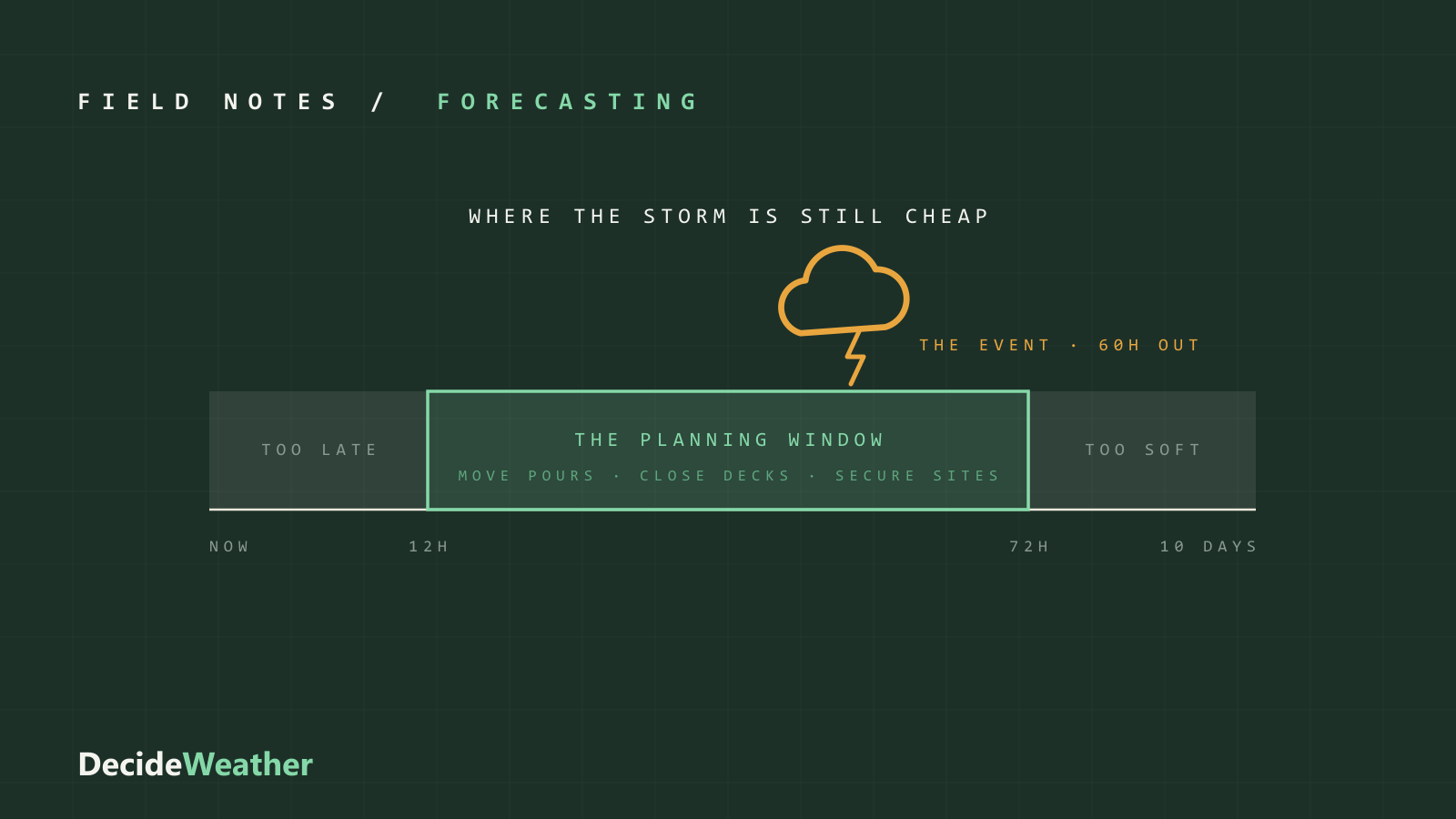
Contractors run two weather instruments: the ten-day, for rough scheduling, and the radar, for the next hour. The money lives between them. By the time the radar shows the storm, every option costs something — the deck is open, the concrete is ordered, the lifts are on rent. Three days earlier, the same storm was already in the forecast and every one of those decisions was still free. The 12-to-72-hour window is where weather stops being luck and becomes logistics.
Why this window, specifically
Inside about 12 hours, forecasts are sharp but your schedule is rigid — trucks are dispatched, crews are committed. Beyond about three days, the schedule is flexible but the forecast is soft — chasing every day-seven possibility whipsaws the calendar for nothing. Between them sits the overlap where confidence and flexibility are both high: an event-scale system at 48 hours is usually real, and 48 hours is enough to re-sequence a week.
The discipline is separating event-scale weather from ordinary variation. A few tenths of rain is a trade-level call — a workday-window question. A system dropping multiple inches, a foot of snow, winds pushing toward severe criteria, a 100-degree stretch, or hard sub-zero cold is a different species: it stops every trade at once, and it undoes finished work — green concrete, open roofs, unsecured staging, standing trenches. Ordinary weather costs you a day. Event weather costs you the week you didn’t prepare for it.
What 48 hours buys, concretely
- The pour moves before it’s ordered. Two days out, shifting a pour ahead of a rain system is a phone call — and ahead of a cold snap, it’s the whole slab.
- The deck stays closed. A tear-off scheduled into day two of a wet system gets swapped for repair-backlog days — the asymmetry only works with lead time.
- Wind prep happens in calm. Securing material, laying down scaffold netting, de-renting the lift — cheap Tuesday, frantic and dangerous Wednesday night.
- The good days get loaded. The same forecast showing Thursday’s storm is showing you Tuesday and Wednesday. Front-load the weather-critical work; put the right crew on the right site while the window is open.
Making the heads-up automatic
The catch: this window only pays if someone is actually watching it for every site, every day — and site-by-site vigilance is exactly what falls off during busy weeks, which are when it matters. That’s a job for an alert, not a habit.
It’s one DecideWeather does out of the box: when an event-scale threat enters the forecast for one of your sites — heavy rain by storm total, heavy snow, damaging wind, extreme heat or cold — it pushes an alert in that 12-to-72-hour window, once per event, sized to event-scale thresholds so it only speaks when the answer is “re-plan the week,” not “pack a jacket.” The radar tells you what’s here. The planning window is where you decide it won’t matter.