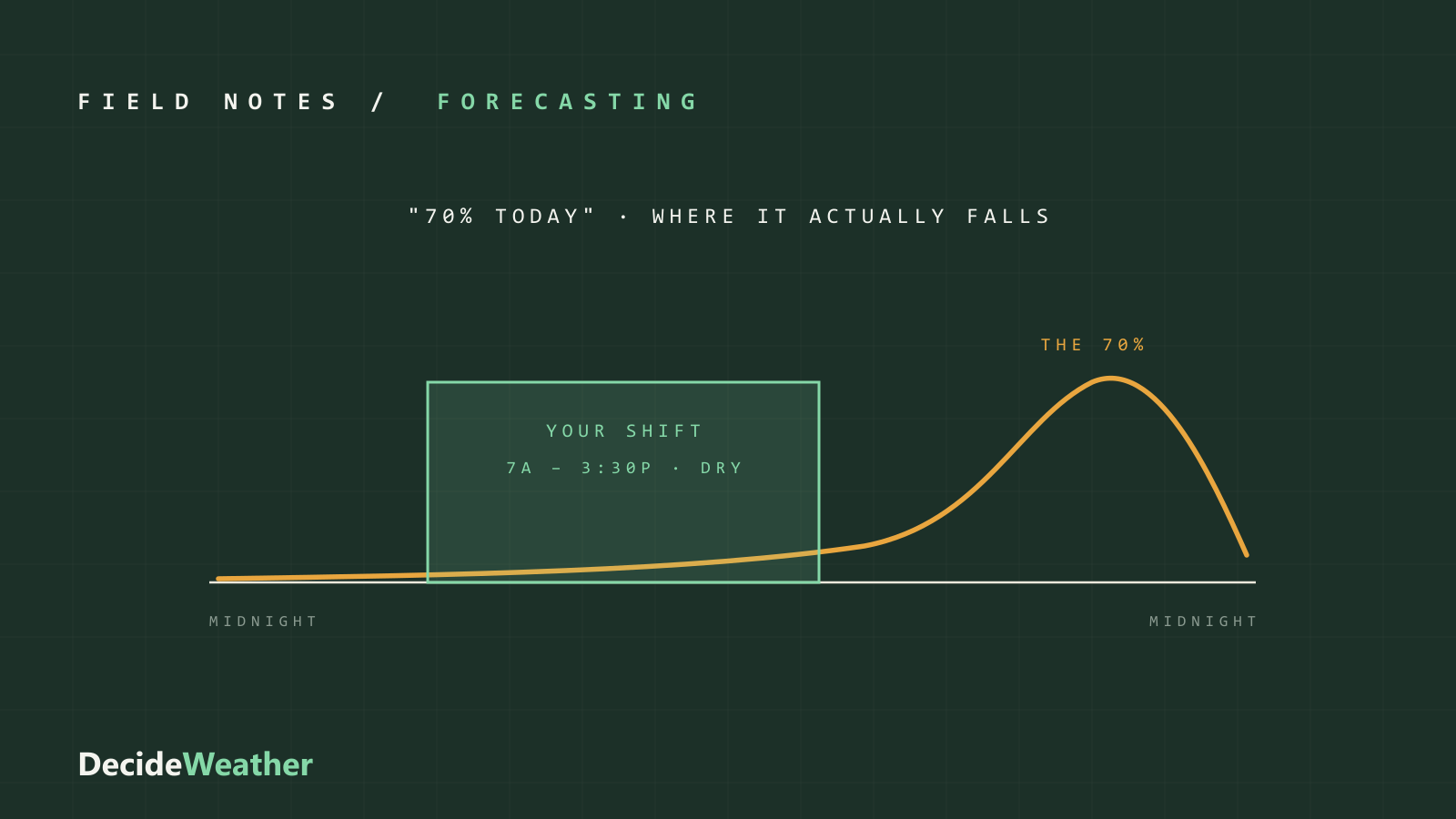
We’ve written about what a 40% chance actually means — coverage, confidence, and the ways the number gets misread. This is the other half of the problem, and for a working crew it’s the bigger half: the daily number is answering a question about the wrong hours.
Two days, same headline
Day one: 70% chance of rain. The system arrives at 6 p.m., rains hard through midnight. Your crew works 7 to 3:30. They never open an umbrella.
Day two: 30% chance of rain. One band, moving through between 9 and 11 a.m., a third of an inch. That’s a shut-down morning and a surface that’s drying into the afternoon — the 30% day cost more work than the 70% day.
Neither forecast was wrong. The daily probability summarizes a 24-hour calendar day, and a crew occupies maybe nine of those hours. Any summary of the wrong window will be wrong in both directions, routinely — dry shifts canceled off scary headlines, wet mornings walked into off comforting ones. If you make the call off one number, make it a number scoped to the shift.
The workday is the window
The fix is almost embarrassingly simple: read the forecast over your working hours and ignore the rest. Hourly rain chances and amounts from clock-in to clock-out — the worst hour your shift contains, and how much water falls inside it. That’s the whole trick, and it changes real decisions:
- Evening-loaded days come back. Summer patterns love late-afternoon and evening convection; crews that start at 6:30 dodge a lot of it. A 60% day with the loading after 4 p.m. is a workable shift with a hard stop, which is a plan, not a cancellation.
- Overnight rain stops mattering — mostly. Rain that ends at 4 a.m. doesn’t fall on anyone, though what it leaves behind still gates the surface trades.
- Early-loaded days get called honestly. A modest daily number with its rain squarely mid-shift reads as what it is.
- Timing inside the shift starts to matter. Rain at 7 a.m. versus 1 p.m. is a different day for a pour that needs hours before weather — the shift-scoped view is what makes the pour-time conversation possible at all.
One number per shift, not one per day
This is how DecideWeather frames every rain figure: the chance shown for a workday is the peak chance inside your working hours, and recommendations are computed over those hours — your schedule, set once per site. Forecast-change alerts run on the same frame, firing when the expected rain total inside the workday crosses the line that changes your answer, not when an overnight number twitches. The daily headline is what the radio reads; the workday number is what the schedule runs on.