Fall is when lawn care companies earn the next spring. The dandelions and clover that survived summer are pulling sugars into their roots to get through winter, and a systemic broadleaf herbicide applied now travels down with them. That makes it the best kill of the year on perennial weeds, if the spray lands where you aimed it, stays there, and has time to work. All three depend on the weather.
Wind: the band, not the maximum
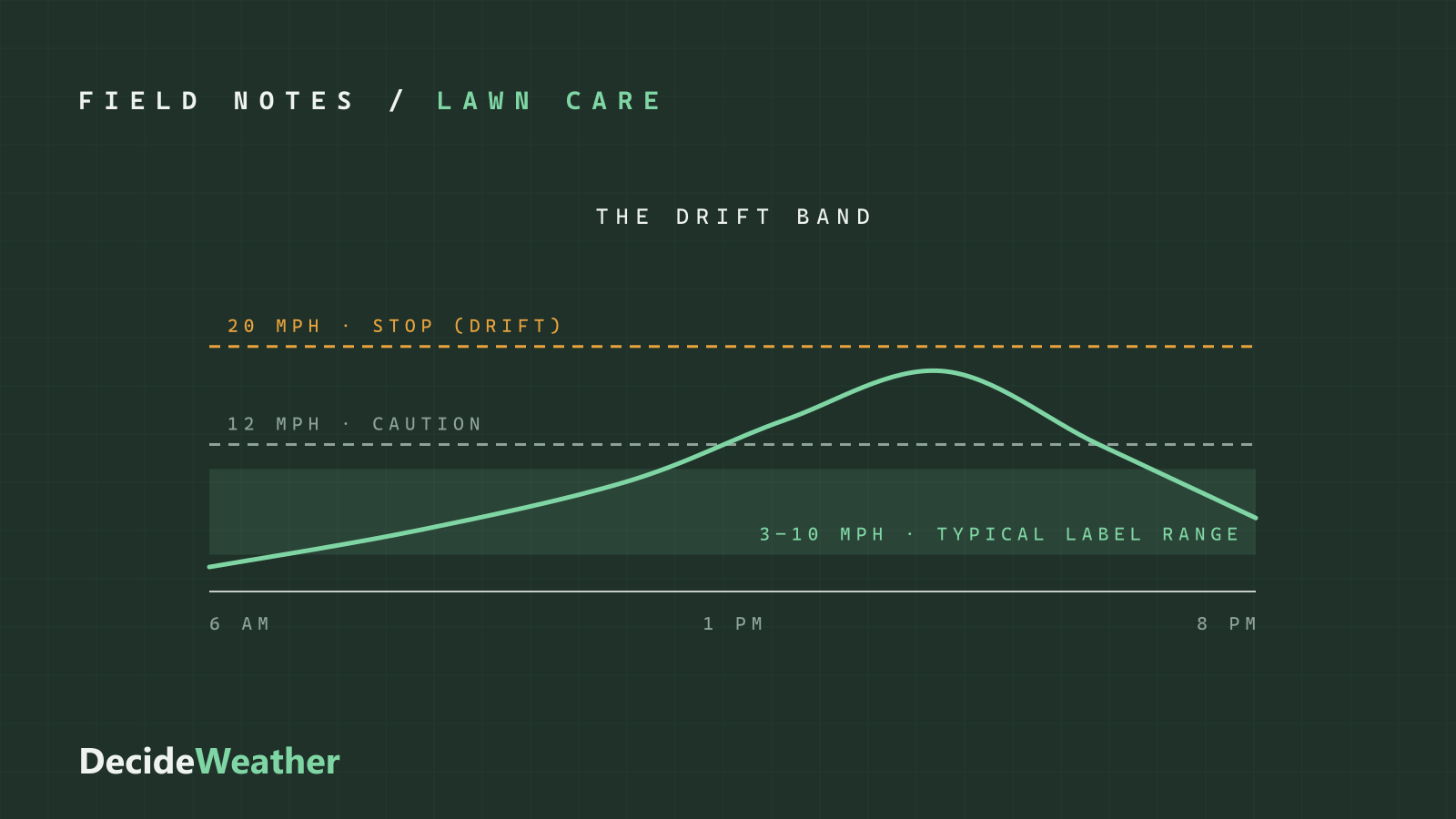
Every turf herbicide label has drift language, and many name a wind range. 3–10 mph is common. That’s a band, not just a ceiling:
- Above the band, fine droplets drift. On a 15 mph afternoon, a lot of what leaves the nozzle ends up in the neighbor’s vegetable bed or on the ornamental maple, and the liability for that is yours.
- Below the band, you can run into inversions. On calm, cool mornings, air near the ground can be colder than the air above it. Fine droplets hang in that layer and move sideways over long distances. Dead calm at 7 a.m. isn’t the safe answer it looks like.
- Inside the band, with steady wind blowing away from sensitive plants, is where the product does its job.
Fall wind has a pattern. Behind cold fronts, gusty northwest wind can blow for a day or two. Mornings usually start calm and pick up by early afternoon. The best spray hours are often mid-morning: after any inversion lifts and before the afternoon gusts build.
Temperature: warm enough to work
Systemic herbicides work because the plant is actively moving sugars around, and that slows in the cold. Many broadleaf products work best on days above about 50–60°F, and labels often advise waiting until weeds have recovered after a hard frost. A cold, frosty morning followed by a 55°F afternoon is a later start, not a lost day.
Rain: the window after the spray
The label’s rainfast time, the dry period a product needs before rain can’t wash it off, ranges from under an hour to a full day. Two kinds of rain matter:
- Rain in the next few hours washes product off the leaf before it’s absorbed. It’s the same clock that governs liquid fertilizer.
- Heavy rain later in the day can move product off the site entirely, which matters on slopes and near storm drains.
A 30% chance of an evening shower on a four-hour rainfast product is a real question. On a 30-minute product it’s much less of one.
Seeing the spray hours
DecideWeather’s Fertilize operation covers liquid applications, and it checks the same three things.
- Wind: sustained wind from 12 to 20 mph, or gusts from 18 to 25, is a Caution for drift. Sustained wind of 20 mph or more, or gusts of 25 or more, is a Stop.
- Temperature: air below 50°F is a Caution.
- Rain: 0.02 inches or more in the next four hours is a Stop, and heavy rain later in the day is flagged too.
These are weather limits, not a replacement for the label. Where the label is stricter, the label wins, and many labels are stricter on wind.
Where the app helps is finding the hours. The Job Site card shows the day’s verdict with the hourly detail underneath, so a route manager can see that a site is sprayable from 9 to noon and done after that. When a day’s rain outlook for the operation moves significantly in the next three days, Alerts sends a push, so you don’t find out about the change when the rig is already loaded.