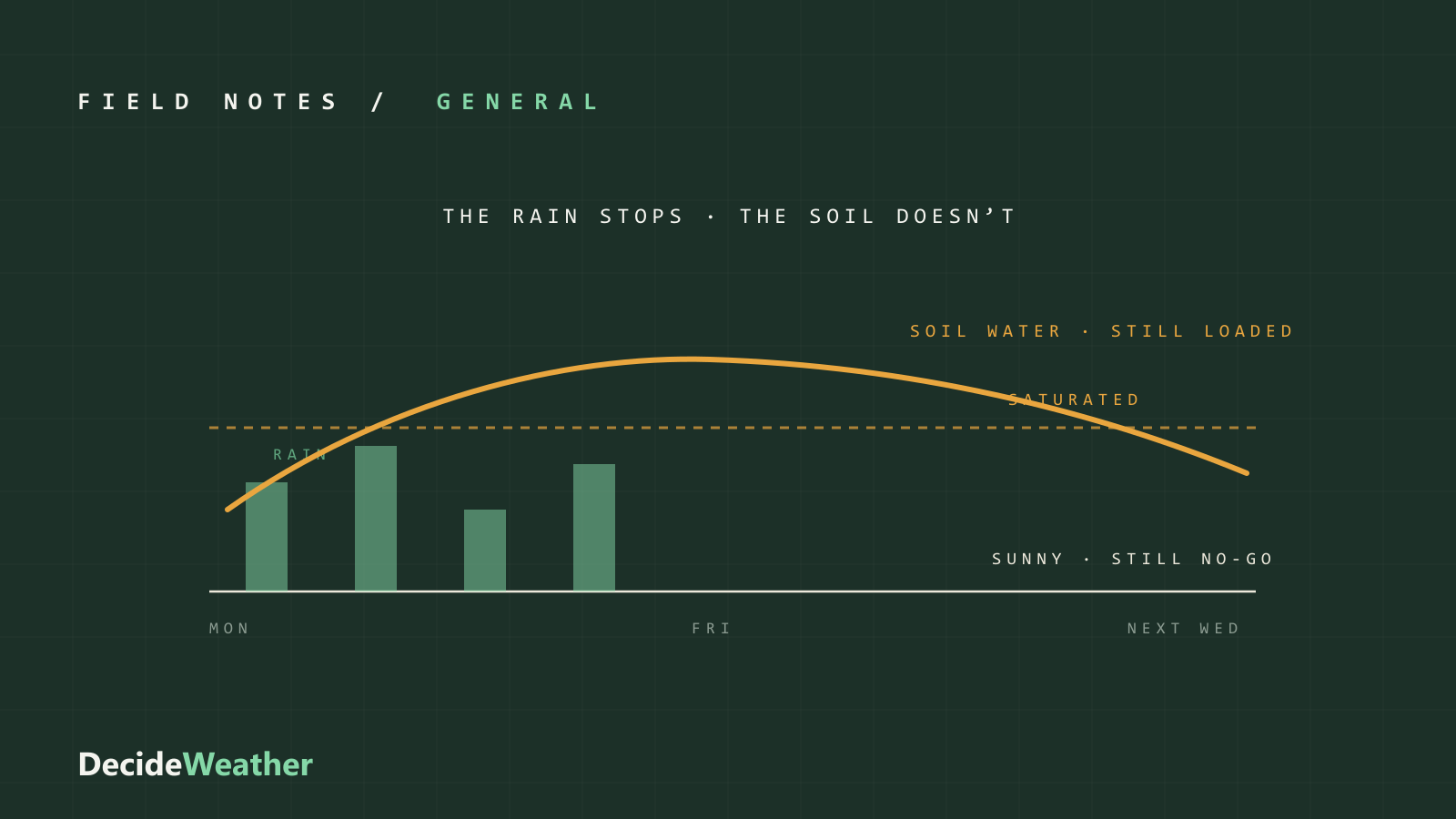
A wet week ends. Saturday is glorious — sun, breeze, not a cloud on the ten-day. The roofing crew works, the framers work, and the excavation contractor who mobilizes anyway spends the morning cutting ruts, watching a trench weep, and towing a skid steer. The sky told the truth; it just wasn’t the relevant truth. After enough rain, the forecast that matters moves underground, and it updates on a much slower clock.
Saturation is a bank balance, not a weather report
Soil holds water like an account holds money: each rain deposits, and drainage plus evaporation withdraw — slowly. A half-inch on dry ground is gone from the working layer in a day. The same half-inch landing on ground still carrying Monday’s inch-and-a-half pushes the profile toward saturation, and saturated is the state where everything about earthwork stops working at once: bearing collapses (rutting, stuck iron), cuts stop holding (and the OSHA classification you had is void), and compaction becomes physically unavailable — wet soil pumps under the roller instead of densifying, so the day’s fill is next week’s re-work even if you can drive to it.
The bank-balance frame explains the two things crews consistently misjudge:
- Sequence beats totals. An inch spread over five drizzly days may leave ground more workable than an inch in one cloudburst on already-wet soil — what matters is the running balance, not the rain gauge.
- The recovery has momentum. After a genuinely wet week, one dry day withdraws a little; it doesn’t zero the account. Clay-heavy sites can hold no-go saturation for several dry days running — the same physics that keeps mowers off soft turf scaled up to twenty-ton equipment.
Ground work runs on different rain math anyway
Here’s the part worth internalizing even in a dry month: earthwork’s relationship to rain was never the same as the surface trades’. A tenth of an inch that holds a sealcoat crew all afternoon is noise to a mass excavation. Ground work tolerates more rain while the ground is dry — and then, once the profile loads up, tolerates none at all, including the dry days after. The gate isn’t today’s shower; it’s the accumulated state of the site. Which means the daily rain chance — already the wrong number for most crews — is doubly wrong here: you can lose zero-percent days and work forty-percent ones.
The field reads that anchor the call: does the ground bear a loaded machine without rutting, does a fresh cut stand clean, does a handful mold and stay molded (too wet to compact) or crumble (workable)? And the schedule read that saves mobilizations: count the site’s water balance, not the days since rain.
DecideWeather runs ground work on exactly this logic — the recommendation carries a soil-saturation signal for the site, holds earthwork while the profile is loaded regardless of a clear sky, and gives excavation its own looser rain thresholds while the ground can still absorb them. The wet week ends when the soil says so; the recommendation just says it out loud.