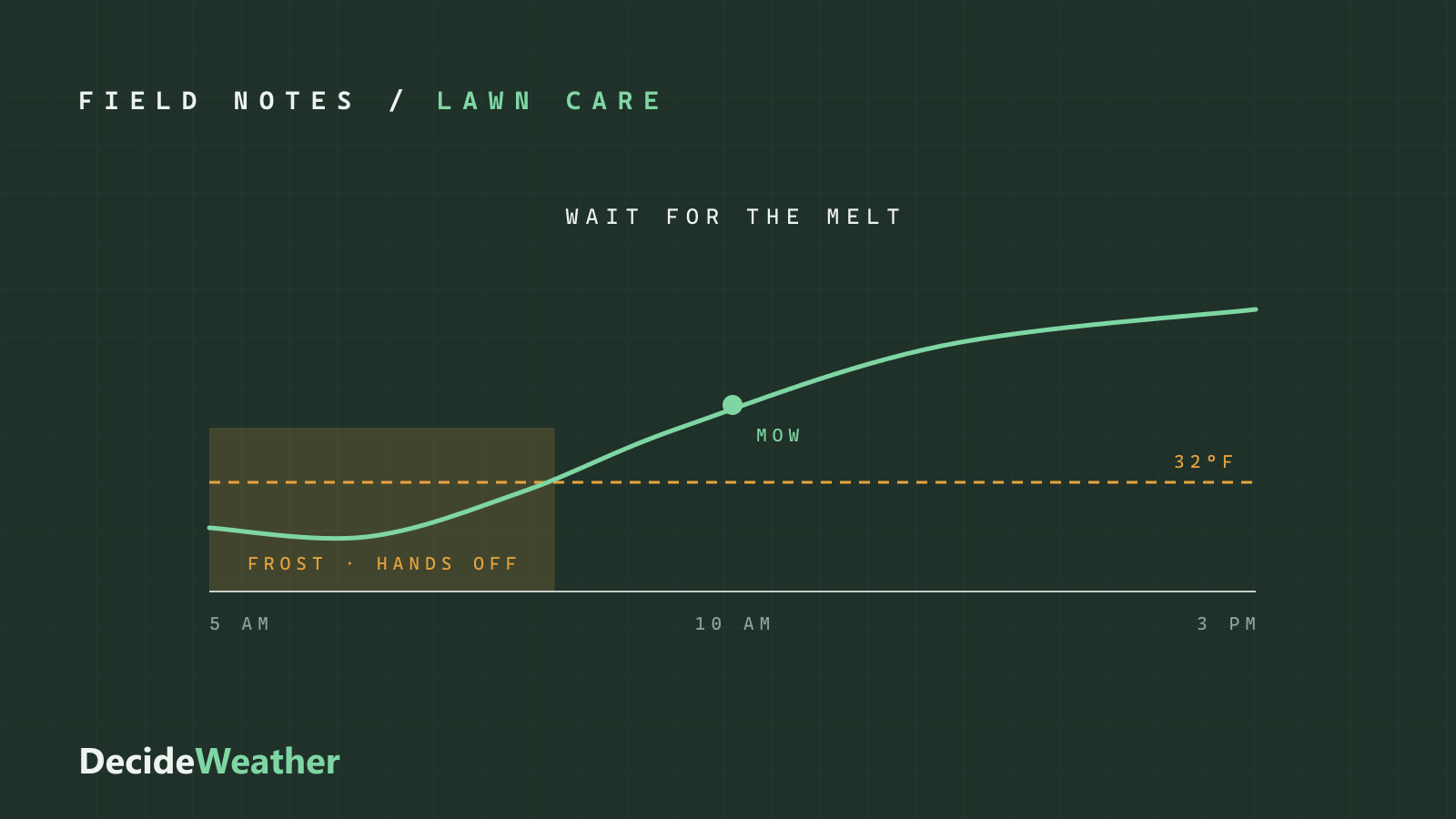
The first frosty morning of fall is a scheduling problem for every mowing route. The crew is on the clock at 7:30, the lawns are white, and the mowers are loaded. Sending them out anyway feels like saving the day. It usually costs the customer’s lawn.
What frost does to grass
Frost on turf is ice on the blades and, on colder nights, ice inside them. Frozen blades are brittle. The weight of a mower, a crew member’s boots, or a trailer tire crushes the frozen cells, and those cells die. The lawn looks fine when the crew leaves. A few days later, every wheel track and footprint shows up brown or black, and in cool fall weather the grass grows so slowly that the tracks can last for weeks.
That’s a callback on a lawn you did right all season.
Frost forms warmer than the forecast low
The forecast low isn’t the temperature at the grass. On clear, calm nights, grass radiates heat to the sky and can cool several degrees below the air temperature measured at head height, which is where forecasts and thermometers measure. That’s why lawns frost with a forecast low of 34–36°F. It’s the same surface-versus-air gap that shows up on roofs and pavement.
Frost is most likely when:
- the sky is clear overnight (clouds act as a blanket),
- the wind is calm,
- the dew point is close to the temperature,
- and the site is low-lying, where cold air pools.
When to send the crew
- Wait for the melt, not the sunrise. Frost on sunny lawns can be gone by 9 or 10 a.m. Shaded yards, north slopes, and low spots can hold it until noon.
- Re-order the route. Start with properties that get early sun, and move shaded and low-lying lawns to the afternoon.
- Keep off the turf entirely. Frost damage comes from feet as well as wheels. Blowing, edging, and trimming across a frosted lawn does the same damage.
- Watch for frozen ground. Once the soil itself freezes, heavy equipment on turf is a no-go for the day, and so is late-season fertilizing.
After the frost melts, the lawn is often wet, and wet turf has its own rules: soil saturation decides rutting, and not every lawn dries at the same rate.
Frost in the forecast
DecideWeather’s Mowing operation flags frost-likely hours as a Caution: air at or below 32°F, above 10°F, with the dew point within 5°F of the temperature and no precipitation. Because blades can frost with the air a few degrees warmer than that, treat the flag as the conservative case. On a clear, calm night with a low in the mid-30s, check the lawn anyway.
Frozen soil is a Stop. When the top few inches of soil are forecast at 32°F or below, the Mowing and Fertilize operations are closed for those hours. The TONIGHT tab on each Job Site card shows the overnight low and sky, which is often enough to know the night before that tomorrow starts late.