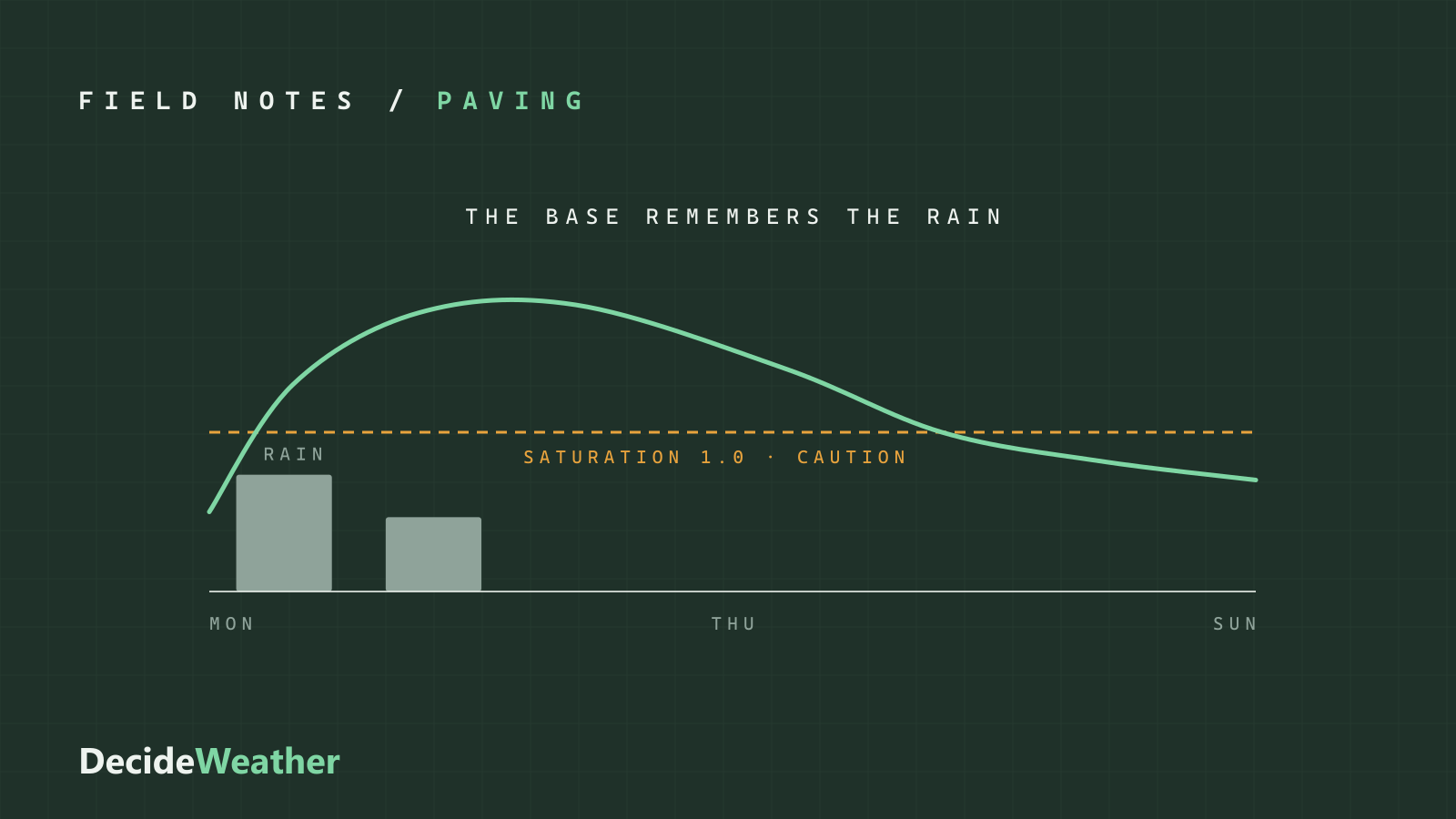
Asphalt is flexible pavement: it spreads the load from traffic down to the layers beneath it. That means a pavement is only as good as the base and subgrade under it. After a wet week, the surface can look ready by Wednesday while the soil two feet down is still holding the weekend’s rain.
What a wet base does
Soil gets its strength from particles pressing against each other. Fill the spaces between them with water and that contact weakens, so bearing strength drops, sometimes sharply. On a paving job, that shows up as:
- Pumping: fine soil and water squeezed up through the base under repeated loads.
- Deflection: the base moving visibly under a loaded truck.
- Rutting and cracking: pavement laid over a soft spot settles into it. The ruts and cracks show up months later, when the crew is long gone.
That’s why most state DOT specifications prohibit placing asphalt on a wet, frozen, or unstable base, and why proof rolling exists.
The surface dries first
After rain, surface water is the first question, and it answers quickly. The base answers slowly, and how slowly depends on the soil:
- Sand and gravel drain fast. A sandy site can be ready a day after heavy rain.
- Silt holds more water and drains slowly.
- Clay holds water for days, swells, and loses strength when wet. A clay subgrade after a soaking can stay soft well into the next week.
We’ve covered the same effect for ground work: after a wet week, the soil is the forecast. The rain has stopped, but the ground is still dealing with it.
Judging the base
- Proof roll. Drive a loaded tandem or roller over the base and watch for movement. It’s the test that settles it.
- Watch the low spots and the edges. Water collects there, and they’re usually the first to fail a proof roll.
- Don’t pave over pumping. A small soft spot can be undercut and replaced. Paving over it just hides it for a season.
- Count the rain from the whole week. Three separate half-inch rains can saturate a clay subgrade as thoroughly as one soaking.
Soil moisture, site by site
DecideWeather’s Paving operation reads the ground, not just the sky. It tracks forecast soil moisture near the surface for each site and compares it to what that site’s soil type can hold. That produces a saturation index, and at 1.0 or above the Paving operation flags a Caution. The index is based on the soil texture at each site, so a clay site and a sandy site can give different answers after the same rain.
Rain itself carries its own limits:
- Stop: 0.15 inches or more in the past three hours, or any rain falling.
- Caution: 0.05 inches or more over the past eight hours.
- Frozen ground: soil at 32°F or below near the surface is a Stop for paving.
Work Windows ranks each site’s best stretches over the next ten days. After a wet week, that’s often the quickest way to see which job sites dry out first and which are better left until next week.