Every roofer has had the morning: the sky is gray, there’s a fine mist on the windshield, and the forecast says “light rain possible.” The crew is loaded. The customer is expecting a tear-off. It doesn’t feel like rain. The question is whether the roof agrees.
What moisture does on a roof
The problem with roofing in rain isn’t comfort. It’s what gets sealed in.
- Decking. OSB and plywood absorb water at the edges and surface and swell. Swollen decking telegraphs through shingles as ridges and buckles.
- Underlayment. Felt wrinkles when it gets wet and dries unevenly. Synthetic underlayment sheds water, but water trapped under it stays there.
- Shingles. Nailed over a wet deck, trapped moisture tries to escape through the roof when the sun heats it. That drives blistering and adhesion problems.
- Warranties. Manufacturers’ installation instructions call for a dry deck. Installing over wet decking gives them a reason to deny a claim.
Then there’s the crew. A wet roof is a slippery roof, and granule-covered shingles and synthetic underlayment get very slick with moisture.
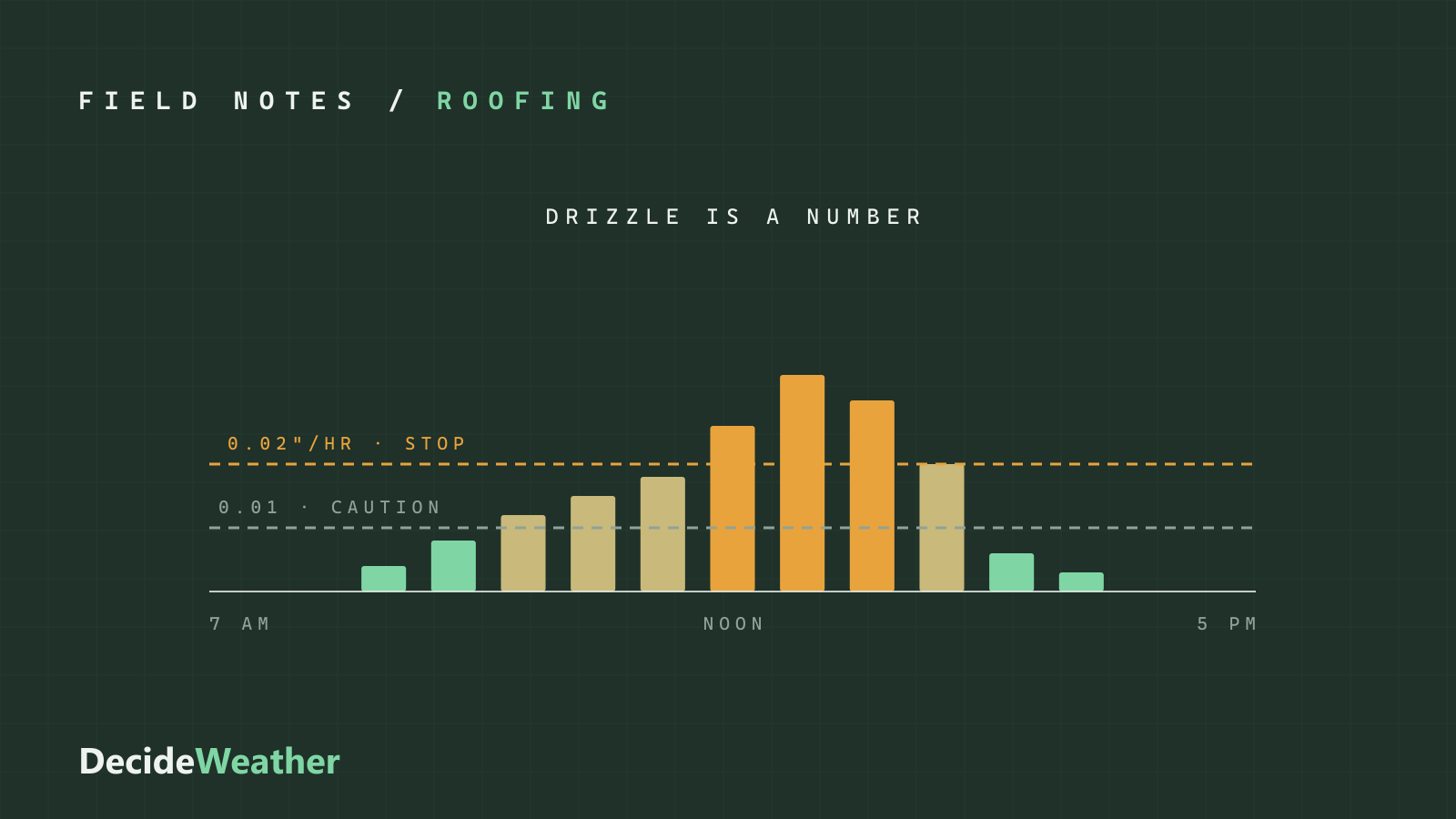
Drizzle is a number
“Light rain” covers a wide range. Weather services measure rain as a rate, and the lower end of that scale is where roofing decisions get made:
- Under 0.01 inches per hour: mist and trace drizzle. Surfaces get damp but may not run with water.
- 0.01–0.02 inches per hour: light drizzle. An open deck is gaining moisture faster than it dries, and every sheet of underlayment goes down over a damp surface.
- Above about 0.02 inches per hour: steady light rain. On an open tear-off, that’s the end of the hour.
Rolling totals matter too. A few hours of sprinkles that never show up as “rain” can still add up to a wet deck by lunch.
Tear-off and repair aren’t the same answer
The rules above are for open-deck work. A patch, a flashing repair, or a tarp job can go ahead in conditions that would stop a tear-off, because the building is closed the whole time and the alternative is a leak. We covered that difference in detail. It’s also why, on a questionable morning, the best move is often to swap the day: run repairs while the drizzle passes and hold the tear-off for the dry stretch.
Hour by hour, not day by day
DecideWeather’s Install / Tear-off operation reads rain the way the deck experiences it: as a rate, hour by hour. Light rain from 0.01 to 0.02 inches per hour is a Caution. Anything above 0.02 is a Stop, and so is a rolling six-hour total above 0.05 inches or a twelve-hour total above 0.08. The Repair operation runs on more forgiving limits suited to closed-roof work, so the same site can show different answers for the two jobs on the same morning.
When the rain is close, radar takes over. During your work hours, DecideWeather sends a push when radar shows precipitation about 30 minutes from the site, and another when it’s about to end with a dry stretch behind it. That’s enough time to get the underlayment down and the materials covered.