Fall is fire season in much of the West, and smoke travels a long way. It can turn a clear-sky forecast in Oregon, Colorado, or Minnesota into a gray, orange-tinged day with an Air Quality Index well into the unhealthy range. Roofing crews feel it first, because roofing is one of the heaviest-breathing jobs in construction, and it’s done outside all day.
The hazard is fine particles
Wildfire smoke is a mix of gases and particles, and the particle part, PM2.5 (particles 2.5 micrometers across or smaller), is what drives the AQI during smoke events. Particles that small get past the nose and throat and settle deep in the lungs. Short-term exposure causes coughing, burning eyes, and shortness of breath. It aggravates asthma and heart disease, and it hits hardest when the body is working hard.
That last point is what makes smoke a roofing problem. Exposure is concentration times the amount of air breathed, and heavy physical work raises the breathing rate several times over resting. Carrying bundles up a ladder at AQI 160 delivers far more smoke to the lungs than walking the site at AQI 160.
What the AQI levels mean on a roof
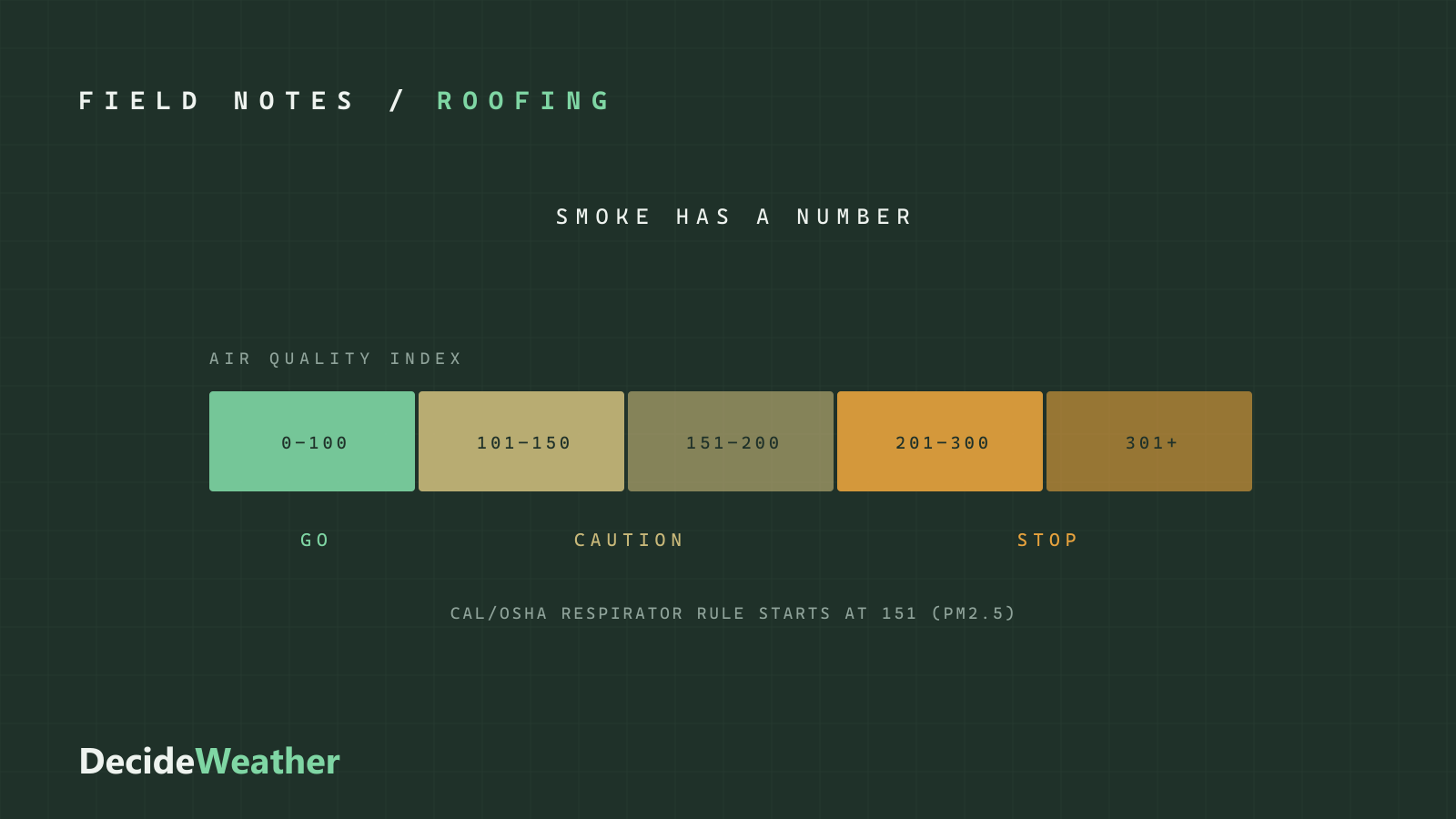
The EPA’s categories, and what they mean for heavy outdoor work:
- 0–100 (good to moderate): normal work. Workers with asthma or heart conditions may already notice it at the top of this range.
- 101–150 (unhealthy for sensitive groups): plan around it. Reduce the heaviest work, add breaks, and watch workers with respiratory conditions.
- 151–200 (unhealthy): limit exposure for everyone. In California, this is where the workplace rule takes effect.
- 201–300 (very unhealthy): strenuous roof work belongs on another day.
- 301+ (hazardous): no outdoor work that can wait.
Where state rules step in
Federal OSHA has no smoke-specific standard, but some states do. California’s rule (Title 8, §5141.1) applies when the AQI for PM2.5 reaches 151. Employers must check the AQI, communicate it to workers, train them, reduce exposure where feasible (by relocating work, rescheduling, or reducing work intensity), and provide N95 respirators for voluntary use. Respirator use becomes mandatory above an AQI of 500. Oregon and some other states have their own smoke rules with different triggers, so check the rules where you work.
Two practical points:
- The sky is a bad gauge. Smoke aloft can make a sky look apocalyptic while ground-level air is moderate, and haze that looks mild can carry an unhealthy AQI. Use the number.
- Smoke and heat compound each other. Early-fall fire events often come with hot weather, and a respirator plus heat plus heavy work is a hard combination. Plan more breaks, not fewer.
Air quality in the roofing call
DecideWeather’s roofing operations read the forecast AQI for each site hour by hour:
- Caution: AQI from 101 to 150, and again from 151 to 200. The upper band is where California’s rule applies.
- Stop: AQI of 201 or higher.
- Every trade: an AQI of 301 or more is a Stop, whatever the work.
Because AQI changes through the day as smoke drifts and mixes, the hourly bar on the Job Site card can show a workable morning and an unhealthy afternoon. That’s worth knowing before the tear-off starts, not halfway through it.